Relations between the Islamic Republic of Iran and the United States are entering an extremely sensitive phase, marked by an unprecedented escalation in U.S. military mobilization in the Middle East and a narrowing diplomatic margin between the two sides.
While American and Israeli media reports speak of an approaching military decision, Tehran affirms that it is pursuing both negotiation and defense tracks in parallel, rejecting what it describes as a “policy of dictates.”
Recent developments reflect a pivotal moment that could reshape the contours of regional conflict, particularly under the administration of U.S. President Donald Trump, which—according to reports—appears closer than ever to the use of force.
The Trump Administration Raises the Level of Threat
According to Axios, citing informed sources, the Trump administration is closer to waging a “major war” against Iran that could begin very soon and last for weeks.
Some circles close to the U.S. president reportedly estimate a high likelihood of military action in the coming weeks, amid growing conviction within the White House that the diplomatic track is nearing its natural end.
In an interview with Fox News, Vice President J. D. Vance stated that talks with Iran “have gone well in some respects,” but noted that the president has drawn “red lines” that the Iranians appear unwilling to acknowledge or address. He added that Trump seeks an agreement, but “will not accept a weak deal.”
Reports also indicate that some of Trump’s advisers have warned against sliding into a broad war. However, according to the same sources, the president has begun losing patience, with assessments suggesting that any potential strike would resemble a comprehensive campaign rather than a limited operation.
Unprecedented Military Build-Up in the Middle East
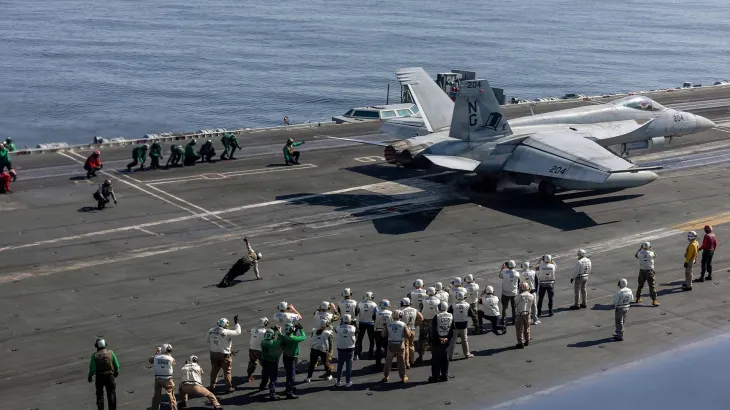
On the ground, the United States has expanded its military deployment to include two aircraft carriers, around 12 warships, hundreds of fighter jets, and advanced air defense systems. More than 150 military cargo flights have reportedly transported weapons and ammunition to the region.
One of the most notable indicators was the movement of the aircraft carrier USS Gerald R. Ford and its full strike group to the eastern Mediterranean—an exceptional step seen as carrying clear strategic messages.
The reinforcement of aerial refueling fleets also enables long-range air operations, whether conducted by the United States alone or in coordination with Israel.
This level of deployment recalls the scale of forces assembled during the 1991 Gulf War, underscoring the seriousness of preparations—even if a final decision has not yet been made.
Tehran: Defensive Readiness and Continued Negotiations
In response, Iran has confirmed that its armed forces are on maximum alert. Following a cabinet session in Tehran to review negotiation outcomes, government spokesperson Fatemeh Mohajerani stressed that authorities are pursuing “the negotiation track and defensive readiness in parallel.”
Iranian Foreign Minister Abbas Araghchi provided a detailed briefing on the progress and mechanisms of the talks, emphasizing that Iran remains open to a diplomatic solution but will not accept conditions that infringe upon its sovereignty or nuclear rights.
Reports suggest that significant gaps remain between the two sides, and proposals presented in Geneva fall short of Washington’s minimum requirements. Despite talk of “progress,” the overall mood within the U.S. administration does not reflect genuine optimism about narrowing the divide.
Israel Between Readiness and Reliance on Washington
In Israel, the Knesset’s Foreign Affairs and Defense Committee has discussed domestic preparedness in the event of military escalation. Committee Chairman Boaz Bismuth stated that Israel faces “significant challenges on the Iranian front,” affirming efforts to ensure home front readiness for various scenarios.
Assessments indicate that any potential military campaign could be a joint U.S.–Israeli operation, with the United States targeting nuclear infrastructure while Israel focuses on Iranian missile systems. However, several sources suggest that Israel would likely play a secondary role in an operation led by Washington.
Regime Change or Targeted Strikes?
One of the central questions concerns the objective of any potential strike: Is Washington seeking regime change in Iran, or aiming to deliver a painful blow to force Tehran back to negotiations under different terms?
According to senior American sources, regime change no longer appears to be a realistic objective, even if it was previously considered. The more probable alternative is a concentrated, days-long military campaign designed to inflict maximum damage on Iran’s nuclear and military infrastructure, thereby compelling future concessions.
However, past experience has shown that assumptions about Iran’s behavior are not always accurate, and any Iranian response could open the door to uncontrolled escalation.
Calculations of Power and Patience
The current landscape reflects a complex equation: a U.S. administration wielding the threat of maximum force to impose new negotiating conditions, and an Islamic Republic that views resilience and steadfastness as essential to preserving its regional standing and sovereignty.
So far, no official decision for war has been announced. Yet the scale of military mobilization, hardened rhetoric, and diminishing diplomatic optimism all suggest that the region stands at a decisive crossroads.
While Tehran continues to affirm its commitment to negotiations and its rights, U.S. pressure is intensifying in an effort to redefine the rules of engagement.
The coming days will determine whether the Middle East is heading toward a major new escalation—or whether the narrow window for diplomacy will remain open.
About the Author