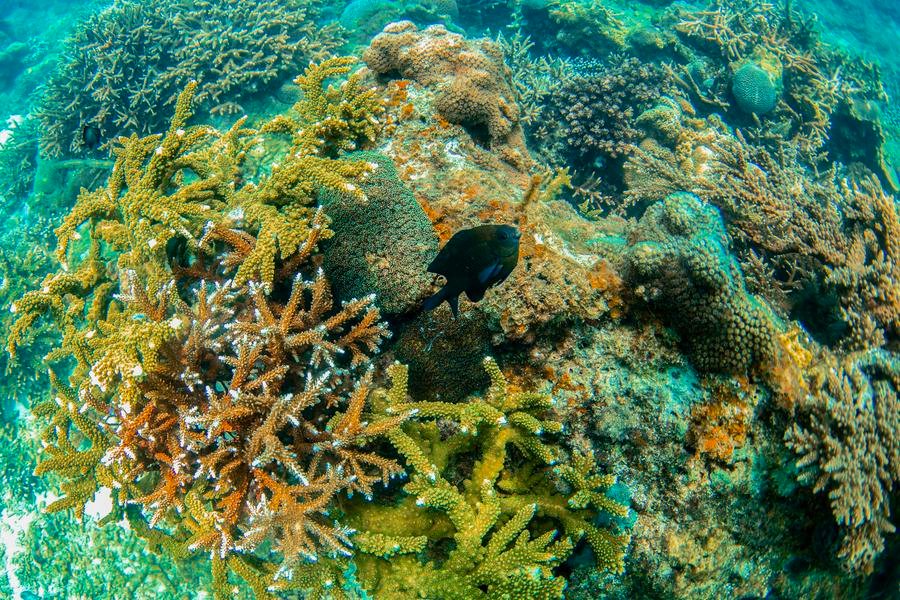
(250607) -- HAIKOU, June 7, 2025 (Xinhua) -- This photo taken on May 26, 2025 shows a scene of the marine ranch in the waters off Wuzhizhou Island in Sanya, south China's Hainan Province. Around 2010, the Wuzhizhou Island in Sanya, a city renowned for its tropical climate and one of the most popular tourist destinations in China, began building China's first tropical marine ranch to restore the underwater ecology damaged by typhoons and fishing activities. The waters surrounding the island contain numerous species such as sea cucumbers, sea urchins, and tropical fish. Marine ranching involves placing artificial reefs, including cement frames and old iron boats, at fixed sites under seawater, which can attract fish, shrimps, crabs, shellfish and other marine life to forage, rest and reproduce. A coral restoration program was launched here in 2016. Since its launch, the marine ranch has transplanted more than 40,000 corals. The coral restoration program has transformed Wuzhizhou, a popular diving destination, into a model of sustainable marine tourism where ecological improvement and tourism coexist harmoniously. (Xinhua/Zhang Liyun)
On the sun-drenched shores of China’s Hainan Island, a quiet economic transformation is gathering pace. What was once primarily a domestic holiday destination has been systematically reimagined as a globally competitive free trade hub and international consumer goods showcase — and the results are beginning to speak for themselves.
This week, Hainan hosted the sixth China International Consumer Products Expo (CICPE), welcoming exhibitors and visitors from across the globe to a showcase of premium goods, lifestyle products, and luxury experiences. The event — which has grown substantially with each annual edition — drew brands from Europe, North America, Japan, Korea, and the wider ASEAN region, all eager to tap into the purchasing power of China’s discerning consumer market in a uniquely advantaged regulatory environment.
Hainan’s attraction as a consumer hub stems directly from its Free Trade Port status, which enables duty-free purchases on a wide range of imported goods. For Chinese consumers, shopping in Hainan offers savings of 20 to 40 percent on many international luxury and premium brands compared to equivalent purchases on the mainland. The result has been a sustained surge in inbound tourism that shows little sign of abating.
But Hainan is more than a duty-free shopping destination. The island’s Free Trade Port framework — one of the most ambitious trade liberalisation experiments in Chinese history — also provides preferential conditions for foreign investment, cross-border data flow, financial services, and multinational corporate registration. For ASEAN businesses in particular, Hainan is increasingly seen as a gateway to the Chinese market and a platform for deeper regional economic integration.
Infrastructure investment has accelerated to match these ambitions. New international airports, upgraded port facilities, world-class exhibition centres, and luxury resort developments are reshaping the island’s physical landscape even as its economic profile evolves.
In Hainan, China is demonstrating that it has both the vision and the capability to build a globally competitive open economy zone from the ground up — a proof of concept for what the next chapter of Chinese economic reform can look like.
About the Author