
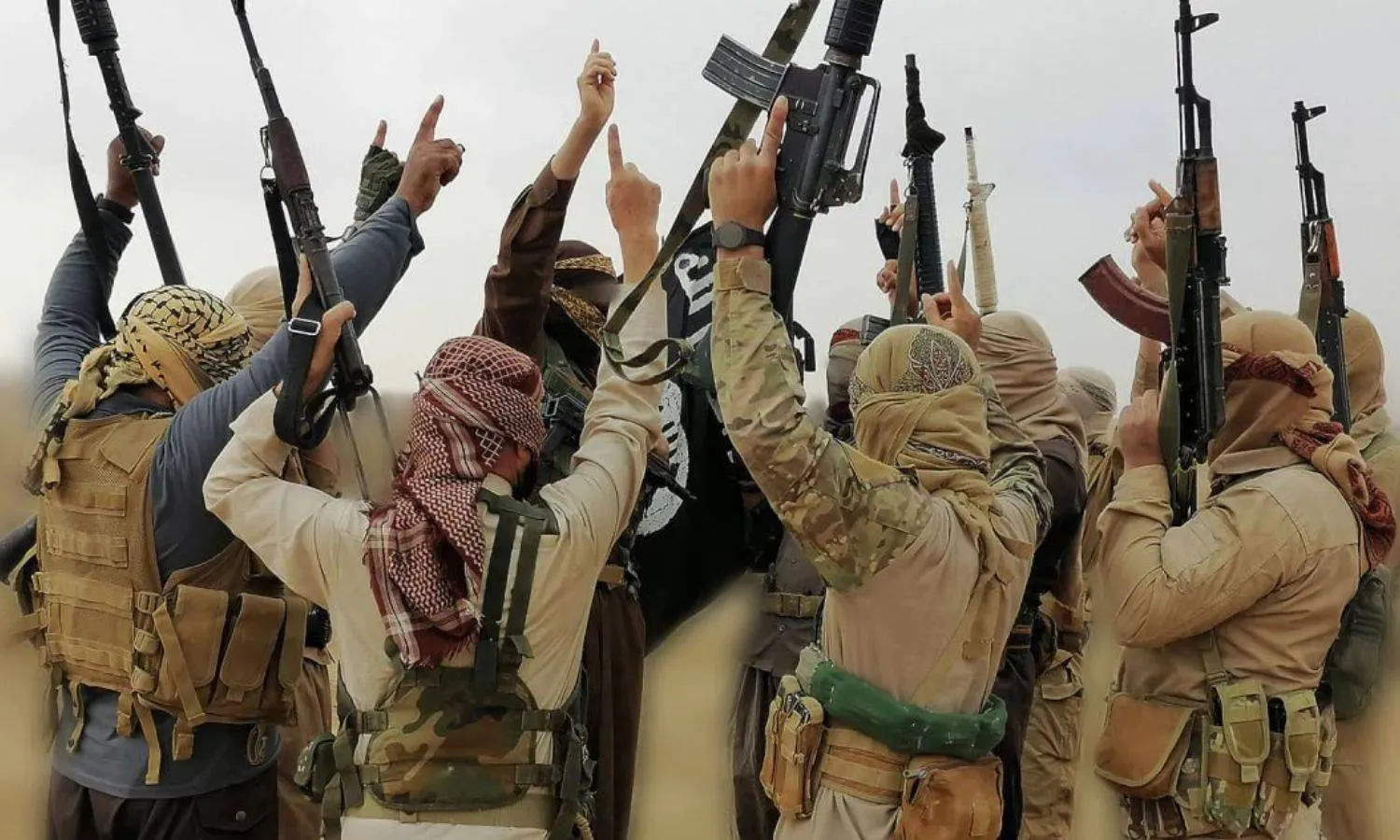
Although more than six years have passed since the territorial defeat of the Islamic State (ISIS) in Syria and Iraq, its sleeper cells continue to operate intermittently, exploiting ongoing security tensions and the vacuum left by the collapse of the al-Assad regime and the prolonged conflict that has plagued Syria for nearly fifteen years. Despite the loss of its territorial control, the group remains capable of threatening regional stability.
The group still survives
Lamar Arkandi, a Syrian journalist specializing in extremist movements, told North Press that “since 2019, the U.S.-led Global Coalition, alongside the Syrian Democratic Forces (SDF) in Syria and the Iraqi army in Iraq, has succeeded in reclaiming territories once held by ISIS. The group has since shifted from territorial control to operating through lone wolves and sleeper cells.”
“Although continuous security and military operations, including air raids, have weakened the group temporarily, they have not eradicated it,” Arkandi explained. “A social base still embraces the group’s ideology and recruits new followers, particularly among children and women.”
She added that ISIS targets minors for indoctrination, offering them money and symbolic ranks, while exploiting women’s vulnerability amid Syria’s economic collapse. “Women can obtain materials used in bomb-making and collect intelligence on military sites, which facilitates terrorist activity,” Arkandi said.
Arkandi noted that ISIS maintains a global presence through affiliates in Africa, Asia, Afghanistan, and Southeast Asia, while its media arms use social platforms to spread propaganda and claim influence.
She emphasized that Syria’s political vacuum and vast desert terrain provide a haven for regrouping and training. The group also exploits abandoned weapons depots left by Iranian-backed militias and has recently begun using drones in operations.
Divisions fuel ISIS activity
Jordanian researcher Saud al-Shorufat, founder and director of the Shorufat Center for Globalization and Terrorism Studies, told North Press that “despite ongoing security operations, ISIS remains capable of maneuvering across the Syrian desert, exploiting weak coordination between government forces and the SDF.”
He added that fragmented intelligence and limited coordination allow ISIS cells to cross zones of control undetected. “The vast desert stretching across Syria, Iraq, and Jordan offers natural hideouts, while economic hardship and poor public services make certain areas more susceptible to the group’s influence,” al-Shorufat said.
He stressed that ISIS’s persistence is not merely a security failure but a structural issue requiring a comprehensive counterterrorism strategy. “Political and administrative divisions in Syria offer a golden opportunity for terrorist groups,” he said. “Control remains divided between the government and the SDF, and local factionalism leaves many areas open to infiltration. Intelligence sharing remains slow and limited.”
Al-Shorufat concluded that widespread instability, the abundance of weapons, and the lack of basic services foster conditions that enable ISIS to expand in poorly monitored regions.
Sleeper cells
Egyptian researcher Munir Adib said that ISIS has undergone major transformations since its creation on June 29, 2014, and the fall of its so-called caliphate on March 22, 2019. “The most dangerous phase began after its territorial defeat, as scattered sleeper and active cells now pose a global threat across vast regions. Some have even reappeared in Europe,” he warned.
He told North Press that “the greater danger lies in sleeper cells capable of reactivation at any moment.” Adib added that wars and conflicts in Ukraine, Palestine, Sudan, Iraq, Syria, and Lebanon further strengthen these networks.
He criticized the Global Coalition’s lack of a clear strategy and noted that the Autonomous Administration of North and East Syria (AANES) and the SDF face internal and external pressures, reducing their counterterrorism effectiveness. “Current efforts are fragmented and reactive, allowing ISIS to regain operational capacity,” he said.
ISIS cells persist despite defeat
SDF spokesperson Abjar Dawoud told North Press that “after ISIS’s final defeat in Baghuz, Deir ez-Zor, the group continued to operate through dispersed cells in areas stretching from the Syrian desert to Deir ez-Zor and Hawl.”
He said ISIS relies on small units of no more than four fighters, which the SDF continues to pursue and dismantle. “Its resurgence is fueled by the political and security vacuum that followed the collapse of the previous regime, as well as access to abandoned weapon stockpiles,” Dawoud explained.
He added that ISIS is attempting to free imprisoned fighters, radicalized women, and children held in camps, emphasizing the need for continued international support. “Any pause or complacency would allow these cells to reorganize and launch new attacks,” he warned.
Dawoud concluded that ISIS continues to reposition and expand its reach, recruiting new members and exploiting instability to strike again with renewed force.
source: North Press
About the Author