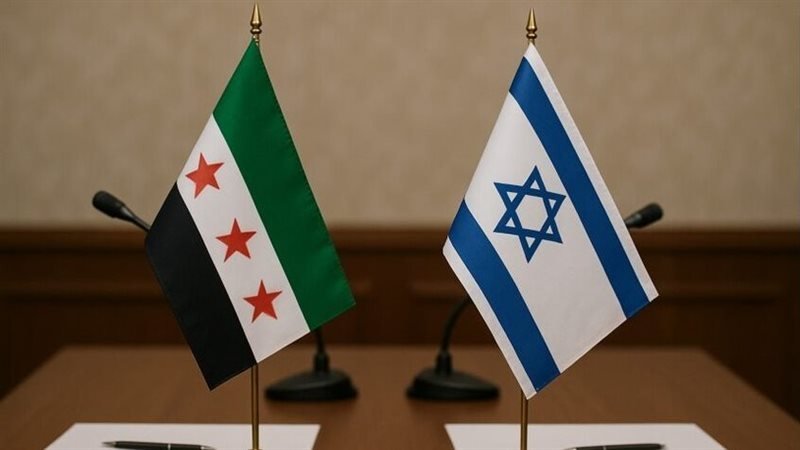
Public discussion of a potential security agreement between Israel and Syria began after a series of indirect messages exchanged by both sides through mediators. Although these contacts have not evolved into a fully fledged political process, officials in both countries have used formal statements to indicate that communication exists, but remains preliminary, conditional, and constrained by the complex military and political reality in southern Syria.
Israeli statements emphasized that any negotiating track remains contingent on creating what Israel views as a “secure” environment in southern Syria and on controlling the presence of non-Syrian military actors there.
Damascus, on the other hand, tied any security understanding to halting Israeli airstrikes and withdrawing Israeli forces from the areas they have advanced into in recent months.
Although these positions have not been translated into written documents or formal understandings, they have formed a general framework that allows what is happening to be described as indirect security negotiations.
Israel’s stated position and its conditions
Israel’s publicly declared statements stressed that any agreement would be conditioned on what it considers “absolute security guarantees” in southern Syria.
Israeli officials outlined four main requirements:
– The removal of non-Syrian forces from southern Syria, particularly groups linked to Iran, with guarantees that can be monitored.
– Preventing the transfer of advanced weaponry through Syrian territory, along with a clear commitment not to use the south as a logistical platform for any military activity directed at Israel.
– Allowing field-monitoring arrangements—whether through international mechanisms or indirect bilateral understandings—to ensure the implementation of any agreement.
– Avoiding the provision of broad political concessions, with officials stressing that the Israeli government “sees no reason to withdraw from sensitive positions without tangible gains.”
These guidelines reflect a cautious official approach. Israeli statements projected skepticism about the chances of reaching a full agreement in the near term, emphasizing that the current situation provides Israel with military advantage, reducing its urgency to advance negotiations.
Nonetheless, Israel has not closed the door to a negotiating track should its security conditions be met.
Damascus’ position and official Syrian statements
Syrian officials’ statements were scattered and indirect, yet they conveyed clear messages about Damascus’ view of what could form the basis of any agreement. The main points included:
– Linking any security understanding to the withdrawal of Israeli forces from areas they recently advanced into in southern Syria, and returning to pre-escalation lines.
– Affirming that Damascus will not accept any arrangements that infringe on “Syrian sovereignty,” meaning rejection of any Israeli military or security presence inside Syria, or even joint monitoring formulas.
– Demanding the cessation of Israeli airstrikes targeting military sites inside Syria as a prerequisite, not a negotiable clause.
– Indicating that Damascus is prepared to consider commitments related to the south, so long as they do not affect Syria’s core military structure.
These statements, though limited, showed that Damascus views the process primarily through the lens of reducing Israeli military pressure and restoring previous lines of control rather than pursuing a long-term security agreement.
Mutual messages through visits and official statements
The most notable development giving momentum to talk of an agreement was the visit by the Israeli prime minister to the south, during which he revealed a number of “details” he described as messages directed at Damascus.
In those remarks, he asserted that Israel “will not allow changes to the rules of engagement” and linked any withdrawal from certain positions to clear Syrian commitments preventing military entrenchment that Israel regards as an immediate threat.
Israeli incursion into southern Syria
The military development that shifted the tone of the talks was Israel’s incursion into parts of the Quneitra countryside and the southern Badia. Although Israel described the move as a “preventive measure,” it represented the first broad field operation in years inside areas beyond traditional friction lines.
Israeli actions included:
– Advancing limited ground units beyond previously observed disengagement lines.
– Establishing temporary monitoring points in areas with diverse military activity.
– Conducting field inspection operations in locations Israel considers potential routes for weapons movement.
Damascus viewed the incursion as a “direct violation” of disengagement arrangements and tied any discussion of a security agreement to halting these actions.
The incursion itself has become a bargaining tool for both sides. Israel presents it as a “tactical measure” reversible if its security demands are met, while Damascus frames it as an issue that must be resolved before any agreement is possible.
Conclusion
Despite extensive discussion, the security track between Israel and Syria remains governed more by battlefield dynamics than political will. Official and semi-official statements from both sides provide a clear picture of the limits of what can be negotiated, while also revealing that neither party currently possesses the capacity to articulate a comprehensive agreement.
What is unfolding today is an approach centered on managing points of contact, regulating movements in the south, and exchanging messages through mediators, without any final formula for a formal understanding taking shape.
About the Author