In an unusual scene since the outbreak of the war, flowers have bloomed again in the heart of Sudan’s capital, Khartoum, with the launch of the Flower Festival—the largest event of its kind in horticulture and natural beauty—organized for the first time since the conflict began in mid-April 2023.
The week-long festival brings together more than 150 companies and producers from various Sudanese states, showcasing a rich selection of plants and seedlings, ornamental flowers, fruit trees, as well as garden and green space designs, including rare species not previously seen in similar exhibitions.
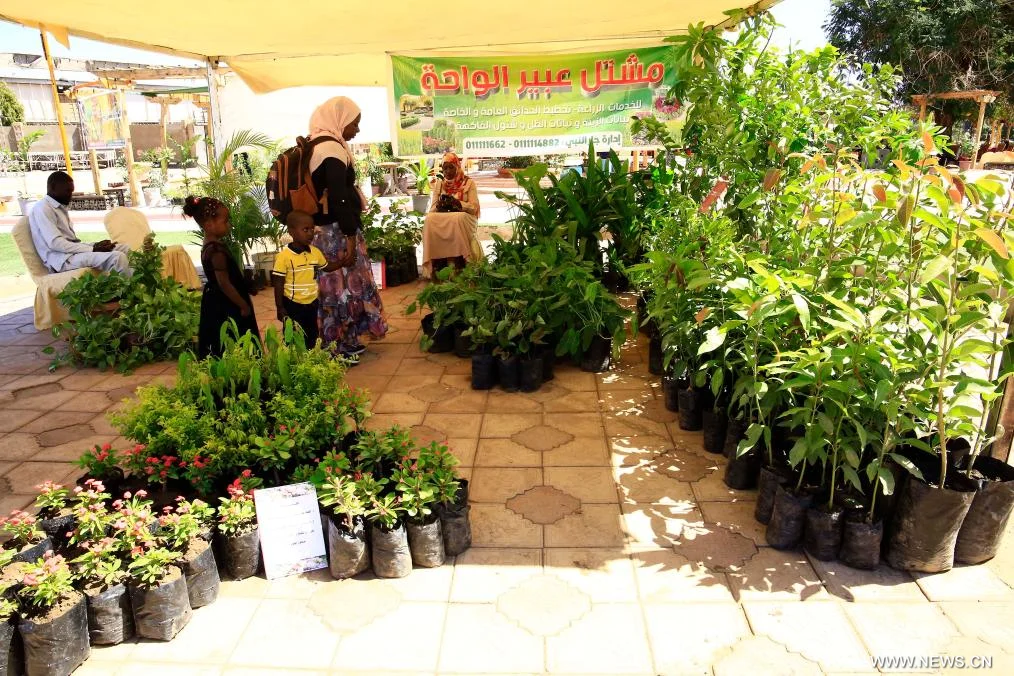
The exhibition booths were meticulously arranged, with flowers lined up in bright reds, yellows, and purples, interspersed with green pathways and carefully planted flowerbeds. Some flowering plants were hung in baskets, while others were placed in pottery reflecting local style. Despite limited resources, the care taken highlighted natural beauty as a message in itself.
Abu Bakr Al-Tayeb, Director of the General Administration of Natural Resources and Forests at Khartoum State Ministry of Agriculture, said the event carries “deep symbolic significance, showing that Khartoum, which experienced destruction and fear, is now reclaiming its civic and cultural face. The Flower Festival confirms that life is stronger than war and that recovery begins with the restoration of public spaces and community activity.”
Al-Tayeb added in a statement to Xinhua News Agency during a tour of the festival, “This is the first exhibition held after the recapture of Khartoum State. Many flowers are being displayed for the first time, in addition to a variety of ornamental and shade plants. We can say that Khartoum is now restoring its green cover.”
Festival halls saw significant visitor movement, with families, youth, and the elderly strolling among the booths, taking photos, and discussing flowers and care techniques.
Near a pavilion featuring local and imported roses, Riham Mustafa, a flower enthusiast, said the festival “brought back a feeling she had long missed.”
She added to Xinhua, “We lived through harsh years when talking about flowers was considered a luxury. Today we feel Khartoum is breathing again. I saw well-known shade and sun plants, as well as flowers and fruit trees.”
She continued, “What caught my attention most was the Araucaria plant, one of the most famous long-lived outdoor ornamental plants, as well as the Pothos, which is one of the best indoor plants for absorbing toxins and improving air quality.”
Ahmed Abdullah, who attended the festival with friends just to observe, said the event carries meaning beyond beauty.
He said, “This garden hosting the Flower Festival was, until a few months ago, a place that instilled fear. Today we walk among flowers—the difference is huge—and that alone gives people hope.”
The festival organizers, Marina Gardens, located near Nile Street, one of Khartoum’s main streets, explained that the goal extends beyond showcasing flowers to supporting local producers and encouraging the green economy.
Mohamed Al-Saudi, director of Marina Gardens and head of the festival’s organizing committee, said, “The return of such exhibitions represents an opportunity to restart production chains that were disrupted for years and carries a message of hope that Khartoum is capable of rising again.”
Al-Saudi added to Xinhua, “Around 150 companies from different Sudanese states are participating in the exhibition. The festival confirms that Khartoum is returning—and so is its green face.”
The Flower Festival comes at a time when Sudan’s capital is gradually resuming economic and social activities after the war caused widespread destruction to infrastructure and deeply affected residents’ lives.
While the conflict’s impact is still present in memory and the urban landscape, the festival appeared as an attempt to restore psychological and social balance through color, fragrance, and human interaction.
Ali Omar, a festival visitor, said, “Among the sounds of visitors, the scent of flowers, and the smiles of sellers, Khartoum, even if temporarily, feels like a city celebrating life.”
He added to Xinhua, “During my tour of the garden hosting the Flower Festival, I saw a variety of flowers and plants. With widespread destruction across many parts of Khartoum, such festivals help restore the city’s aesthetic face.”
The Sudanese government is making intensive efforts to restore normal life in Khartoum by prioritizing the repair of essential services, particularly electricity and water, amid signs of relative improvement in security in some city neighborhoods.
A report by the International Organization for Migration dated January 26 indicated that around 1.4 million people returned to Khartoum. The Sudanese government announced on January 11, 2026, the resumption of its institutions’ work in the capital after officially relocating from Port Sudan in the east of the country.
The Sudanese army announced on May 20, 2025, that it had fully regained control over Khartoum State, confirming the absence of Rapid Support Forces following more than two years of military confrontations.
Sudan has experienced armed conflict between the army and Rapid Support Forces since mid-April 2023, resulting in tens of thousands of deaths and the displacement of millions of civilians inside and outside the country.
Source: Xinhua
About the Author