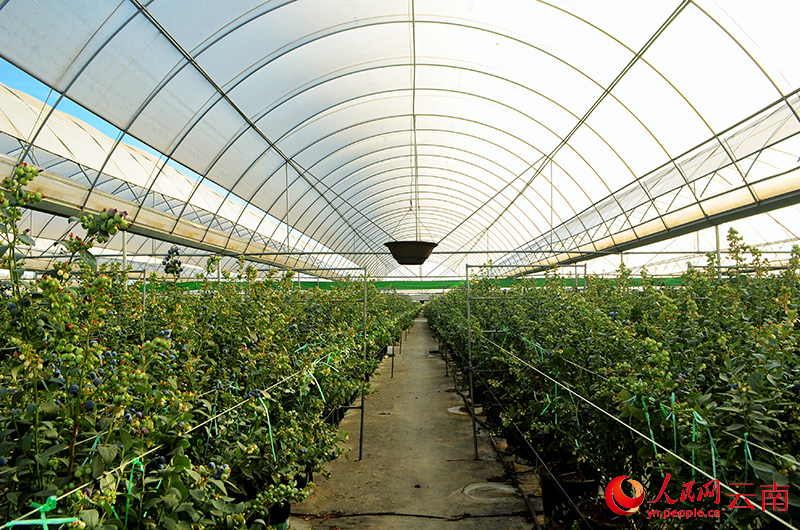
At an ecological agriculture demonstration facility in Chengjiang city, southwest China’s Yunnan Province, workers are busy picking and sorting blueberries destined for Shanghai.

Located at an elevation of between 1,700 and 2,800 meters, Chengjiang enjoys an average annual temperature of 16.5 degrees Celsius, more than 2,000 hours of sunshine annually, and significant temperature swings between day and night. In 2004, the city introduced blueberry cultivation, with the local conditions proving ideal for growing flower-scented varieties.
Guo Jie, a technician at the planting facility, opened an app displaying real-time data on temperature, humidity and sunlight inside the greenhouse. With a tap on his phone, the roof gradually opened.
“In the past, we relied on experience. Now, we rely on data. The smartphone can precisely guide irrigation and fertilizer application,” said Guo.

Guo also described a recycling system that captures surplus water and fertilizers from the greenhouse. “This saves water, reduces chemical fertilizer use, and benefits the environment,” he said.

Such practices reflect the city’s commitment to protecting Fuxian Lake, the largest deep freshwater lake in China. To safeguard the lake’s ecological environment, the city has adjusted its agricultural structure, upgrading blueberry varieties, implementing standardized planting and adopting digital management. By 2025, the recycling system had been rolled out across all blueberry planting facilities in Chengjiang.

Today, “Chengjiang Blueberry” is recognized as a geographical indication product. It is cultivated across 28,000 mu (1,866 hectares) of farmland, with an annual output of 24,000 tonnes and a total output value of 2.3 billion yuan ($333 million).
source: People’s Daily Online
About the Author