It appears that legends of lost cities like Atlantis may not be pure fiction. Researchers at the Russian Academy of Sciences announced the discovery of “remains of a submerged city” beneath the waters of Lake Issyk Kul in Kyrgyzstan.
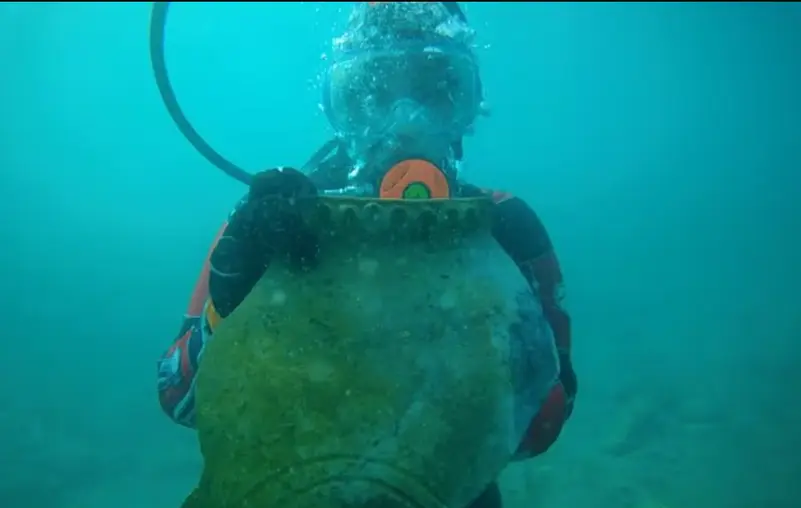
The vast salt lake, the world’s eighth-deepest with depths reaching 668 meters, conceals in its shallow areas the remnants of a medieval city, including an Islamic cemetery, large ceramic vessels, and the foundations of buildings constructed from fired brick.
Researchers believe the site once contained mosques, religious schools, public baths, and possibly grain mills, according to a report published by the Daily Mail.
Valery Kolychenko, head of the expedition, described the city as an “important commercial center” on the historic Silk Road.
Massive earthquake
Findings indicate that the city was destroyed by a massive earthquake in the 15th century, a disaster “similar in scale to Pompeii,” though it is likely that the inhabitants had already abandoned it before the catastrophe struck.
During the survey conducted in the Toro-Aygyr complex northwest of the lake, archaeologists uncovered four underwater zones at depths ranging from one to four meters. These included collapsed buildings, wooden pillars, a large grain-grinding millstone, and a 13th-century Islamic cemetery where skeletons were found facing the qibla in accordance with Islamic rites.
Part of the Silk Road network
The Russian Geographical Society, which funded the project, confirmed that “all evidence indicates that an ancient city really existed here.”
Samples were sent for age determination using mass spectrometry to confirm the exact dating of the remains.
It is believed that this large settlement was part of the Silk Road network, which flourished from the 2nd century BCE until the mid-15th century and served as a hub for the exchange of goods and ideas between Asia and Europe.
But the devastating earthquake caused a major shift in population distribution and the collapse of the urban civilization that had thrived in the region, leaving the city to vanish beneath the waters of Issyk Kul for centuries until science uncovered it today.
source: alarabiya


About the Author