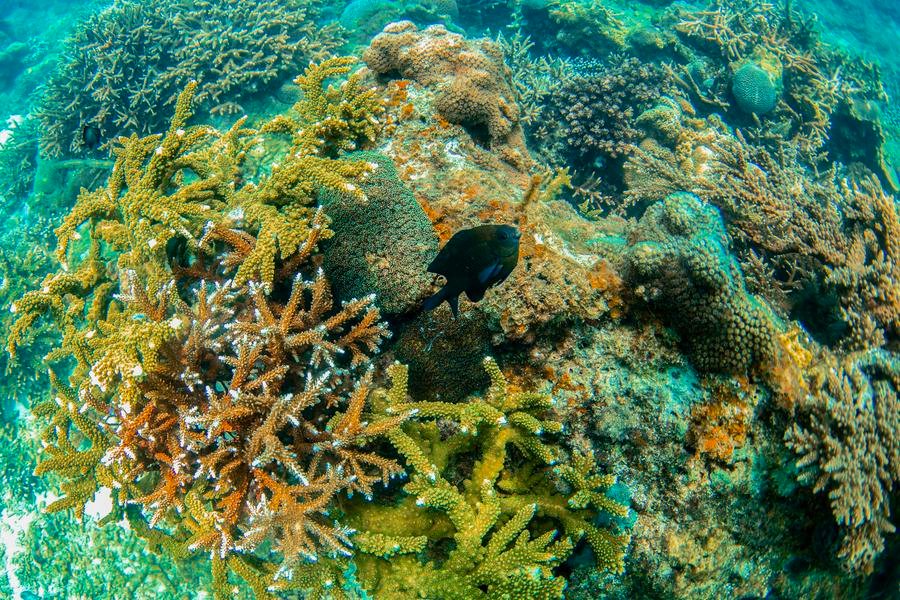
(250607) -- HAIKOU, June 7, 2025 (Xinhua) -- This photo taken on May 26, 2025 shows a scene of the marine ranch in the waters off Wuzhizhou Island in Sanya, south China's Hainan Province. Around 2010, the Wuzhizhou Island in Sanya, a city renowned for its tropical climate and one of the most popular tourist destinations in China, began building China's first tropical marine ranch to restore the underwater ecology damaged by typhoons and fishing activities. The waters surrounding the island contain numerous species such as sea cucumbers, sea urchins, and tropical fish. Marine ranching involves placing artificial reefs, including cement frames and old iron boats, at fixed sites under seawater, which can attract fish, shrimps, crabs, shellfish and other marine life to forage, rest and reproduce. A coral restoration program was launched here in 2016. Since its launch, the marine ranch has transplanted more than 40,000 corals. The coral restoration program has transformed Wuzhizhou, a popular diving destination, into a model of sustainable marine tourism where ecological improvement and tourism coexist harmoniously. (Xinhua/Zhang Liyun)
GUANGZHOU –
A Chinese research team has uncovered a collaborative dynamic in soil microorganisms during a study on the ecological restoration of tropical coral islands, offering a novel strategy for the optimization of vegetation in these fragile ecosystems.
The results of the study, which was conducted by researchers from the Chinese Academy of Sciences’ South China Botanical Garden, were published in the Soil Ecology Letters journal.
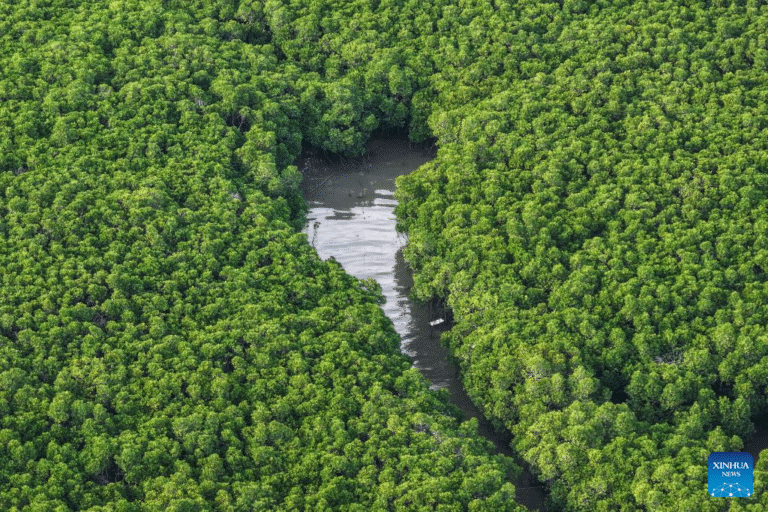
Tropical coral islands have relatively isolated and closed ecosystems with harsh living conditions, and they experience frequent high temperatures, intense sunlight, high salinity levels and seasonal drought. Combined with low levels of biodiversity, simple system structures and weak capacities for self-regulation, these ecosystems are highly unstable.
Meanwhile, artificially established vegetation often struggles to persist and tends to degrade, thus posing significant challenges to restoration and ecological function enhancement efforts.
The study has indicated that although artificial vegetation significantly improves soil conditions and nutrient availability, key metrics such as soil fertility, microbial biomass, enzyme activity and biodiversity during the early restoration stage still lag markedly behind those of natural vegetation.
The research has identified clear collaboration among soil microorganisms during the ecological recovery process. In the initial stages of vegetation restoration, soil fungi efficiently break down hard-to-decompose organic matter thanks to their tolerance to drought and salinity. This creates favorable conditions for plant colonization and plays a central role in stabilizing the microbial network structure.
As restoration progresses, soil bacteria take on a “main force” role in maintaining long-term ecosystem function and stability by promoting the rapid cycling of key elements such as carbon, nitrogen and phosphorus.
Additionally, the study found that soil microorganisms in both artificial and natural vegetation are limited by both carbon and phosphorus nutrients. This suggests that the insufficient supply of soil nutrients on tropical coral islands is a critical bottleneck restricting microbial activity and the efficiency of ecological restoration.
Based on these results, the research team proposed targeted optimization strategies for vegetation establishment. They also recommended longer-term monitoring to assess the sustainability of different restoration models, and the continual improvement of the technical framework for ecological restoration on tropical coral islands, which will provide scientific support for island ecological security and the restoration of vulnerable ecosystems worldwide.
source: Xinhua
About the Author