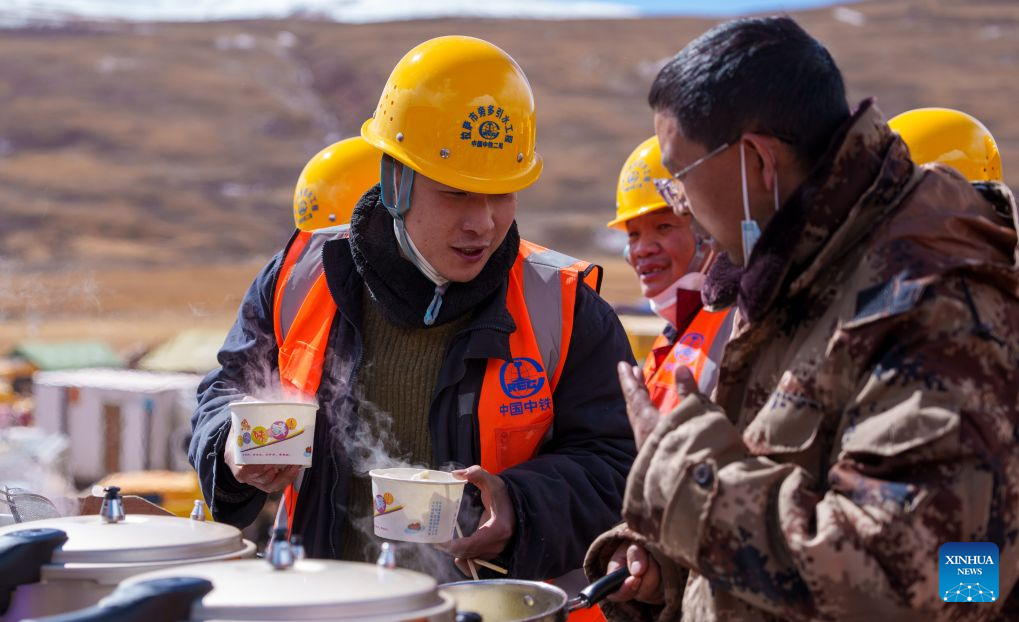
BAQEN, Xizang, Oct. 25 (Xinhua) — Rescue and relief efforts continue after a 7.0-magnitude earthquake struck southwest China’s Xizang Autonomous Region, with public health and epidemic prevention work underway in affected areas, according to local authorities.
The earthquake, which struck Baqen County in the city of Nagqu at 10:33 p.m. on Thursday, has left 16 people dead and 76 others injured so far. More than 12,000 residents were evacuated after the quake.
To prevent public health risks after the quake, disease control teams in Baqen County have carried out comprehensive epidemic prevention work. The work includes infectious disease monitoring of more than 3,600 residents across 35 resettlement sites, disinfection of public areas and high-risk contamination spots, and drinking water safety testing, the earthquake relief headquarters of Nagqu said on Sunday.
In the immediate aftermath of the earthquake, hospitals near the disaster zone swiftly dispatched medical workers for rescue efforts.
On Saturday, a female villager from an affected area with an abrasion on her left ankle told Xinhua, “The doctor arrived before dawn on Friday and promptly applied ointment and bandaged it for me.” A 23-year-old woman, 28 weeks pregnant, also received basic health checks, including vital-sign measurements.
Multiple resettlement sites have set up mobile medical stations, each staffed with health workers ready to treat common illnesses and minor injuries, with regular checkups, medicine supplies, disinfection, and basic psychological counseling.
The epicenter in Baqen County sits at an average altitude of nearly 4,800 meters, where temperatures are already low in late October. Yet inside the tents set up for displaced residents, stoves keep the shelters warm.
On Saturday, the first batch of new-generation emergency relief facilities, including a mobile food vehicle, a water purification station, and an eco-friendly toilet, was put into use in the affected area in Baqen County.
The mobile food vehicle allows four people to work inside the truck-sized box and eight outside at the same time. Meals for 300 to 500 people can be fully prepared in just two hours.
At 6:30 p.m., the first meal off the stove was braised beef with potatoes and stir-fried greens, drawing many residents over to try it.
“The truck is really cool, and the food tastes great too,” said Norbu Tsering, a villager from Maru Township.
“The truck is equipped with a high-pressure rice steamer which can cook 18 trays of rice at once. The stainless steel tableware is washed after use, then sterilized in a disinfection cabinet for the next round,” said Ma Hua, deputy director of the 999 emergency rescue center in Xizang.
Access to clean water is crucial but challenging in the quake-hit plateau, especially in winter.
In Maru Township, a mobile water purification station can purify two tonnes of well water per hour. Equipped with solar power generation, insulation materials and an energy storage system, it is designed to operate in temperatures as low as minus 30 degrees Celsius, said Ji Tao, head of the Baqen branch of the company that provided the purification facilities.
Five administrative villages in Maru Township had already received the water purification facilities, Ji said, adding that coverage would be expanded.
Near the purification station, an eco-friendly toilet with rooftop solar panels and a waterless, flush-free system has been put up. Solar power provides lighting and drives fermentation, while enzymes break down waste in a sealed tank, which can be used as fertilizer, according to Tsewang Ngodrup, an official with the Nagqu municipal science and technology bureau.
More than 5,000 rescue personnel have been deployed at all levels. Relief supplies from central and local governments are arriving in the disaster zone in succession. ■



المصدر: english.news.cn
About the Author