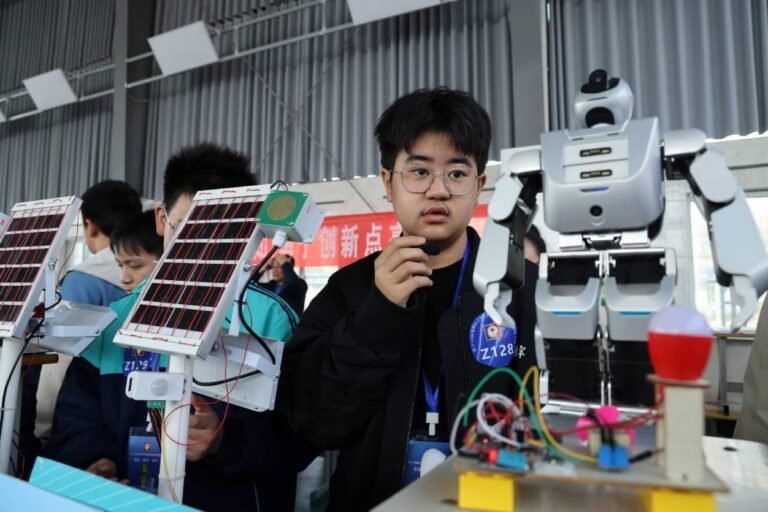

At the U.S.–Saudi Investment Forum held at the Kennedy Center in Washington, Elon Musk presented an extensive outlook on the future of the economy and work amid the accelerating development of artificial intelligence and robotics.
Musk confirmed that Tesla’s humanoid robot “Optimus” will help eliminate poverty in the coming years, noting that humanity will reach a stage where work becomes optional, while physical currency gradually loses its importance as automation technologies expand.
Jensen Huang, CEO of Nvidia, participated in the session and commented on Musk’s remarks by saying he would appreciate advance notice before currencies disappear entirely, highlighting the ongoing debate surrounding the future of the digital and robotic economy.
Optimus and Its Expected Role in the Coming Phase
Musk explained that the capabilities of the humanoid robot Optimus will expand in the next few years to include a wide range of daily and professional tasks.
According to his statements, humanoid robots will provide unlimited labor capacity at low cost and continuous operational ability, enabling the fulfillment of production and service needs on a large scale.
Musk noted that Tesla is working on developing Optimus to perform common tasks in factories, warehouses, offices, and household environments, with the possibility of releasing multiple versions to the market at prices capable of competing with traditional labor costs.
He added that other companies will enter this field as global interest in designing humanoid robots capable of naturally interacting with their surroundings continues to grow.
Artificial Intelligence and Its Role in Reshaping the Economy
Musk said that advanced artificial intelligence will lead to transferring many production and service operations to systems that function without direct human involvement.
He pointed out that intelligent platforms will be able to make operational decisions with high efficiency, allowing the economy to shift toward unprecedented levels of productivity.
In this context, he emphasized that AI’s role will not be limited to technical tasks, but will also extend to managing complex operations across sectors such as industry, transportation, logistics, and healthcare.
According to his estimates, the integration of AI with robotics will accelerate the economic transformation over the next two decades.
Human Labor Between Necessity and Choice
Musk stated that the world is heading toward a stage in which human labor becomes optional, noting that the expected period for achieving this ranges between 10 and 20 years.
According to his remarks, robots will take over most essential tasks, while humans will retain the ability to choose work based on personal interest rather than economic necessity.
He explained that jobs considered essential today will be fully transferred to robotic systems, reducing the need for human labor across various sectors.
Meanwhile, new fields related to creativity, scientific research, and innovation will emerge, not tied to income generation as much as to intellectual and cultural development.
The Impact of Production Abundance on the Structure of the Global Economy
Musk focused on the concept of a “post-scarcity economy,” an economic system based on an abundance of goods and services driven by high production and low costs achieved through robotics and artificial intelligence.
He indicated that production costs will decline sharply due to robots’ ability to operate continuously without traditional operating expenses.
In this model, essential goods shift from products dependent on human labor costs to easily accessible commodities, changing consumption patterns, product pricing, and resource distribution.
Musk said that this stage will reshape the nature of markets, as goods and services become so abundant that the need for purchasing them under the current economic system significantly decreases.
Money in a Smart World: Gradual Decline in Importance
Musk pointed out that money will lose its traditional importance with the development of artificial intelligence and humanoid robots.
He noted that accessing goods and services will become easier than ever before, reducing the need to accumulate capital.
He referenced Iain Banks’ “Culture” series, which imagines an advanced society that does not use money due to abundant resources.
Musk explained that continued technological progress may move the economy into a phase where economic value is no longer linked to currency, but to the ability of intelligent systems to provide needs without direct financial cost to the user.
Conclusion
Musk presented at the forum a future outlook based on the widespread use of humanoid robots and artificial intelligence as key elements in shaping the global economy.
His statements outlined the features of a new era characterized by abundant production, reduced reliance on human labor, and declining value of money due to expanding automation.
This vision highlights that technological progress will lead to substantial changes ranging from the structure of the economy to the nature of everyday life, as robots increasingly perform tasks currently carried out by humans, transforming patterns of work, income, and consumption in the coming decades.
source: Asian Affairs
About the Author