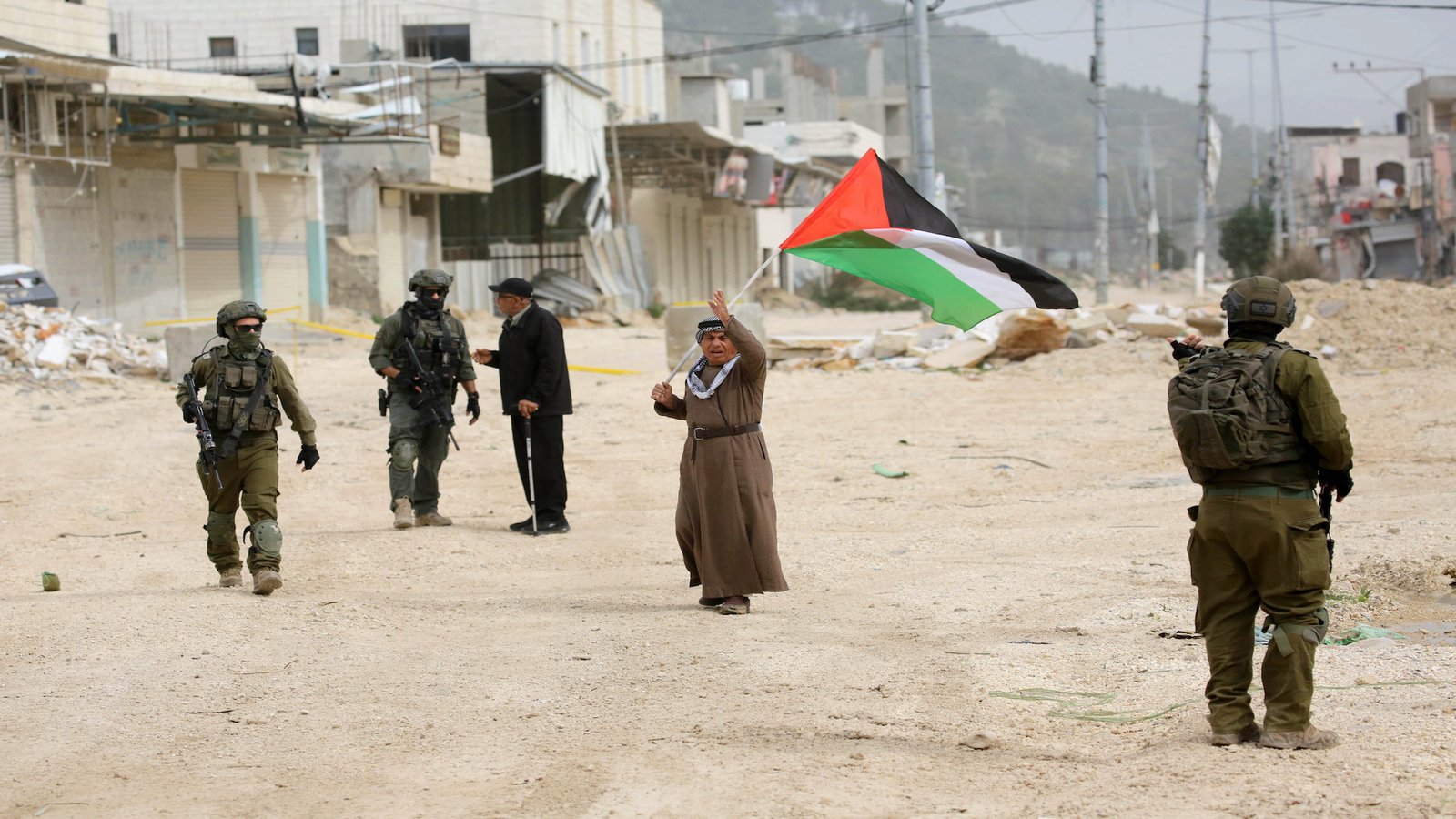
Since early February 2026, the West Bank file has witnessed a qualitative shift in the nature of Israeli policies—not as a conventional field escalation, but as a calculated transition from military control to reshaping the legal structure of land, population, and ownership.
These changes have come through a coordinated package of decisions, legislation, and administrative measures described by observers and experts as the most dangerous alteration to the legal status of the occupied territories since 1967. They go beyond expanding settlements; they redefine the very concept of ownership within the West Bank and open the door to transferring effective control over vast areas to the Israeli state or settlement-linked entities.
The new decisions were issued by Israel’s ministerial cabinet for political and security affairs, granting the government broad authority to register Palestinian land—particularly in Area C—as “state land” if Palestinians are unable to prove ownership under strict and complex documentation requirements.
Area C constitutes more than 61% of the West Bank, meaning that most of the land is now exposed to potential legal reclassification that could transfer it to Israeli control.
Redefining Ownership
The central pillar of the new policy is what has been referred to in the media as the “State Property Law,” a legal framework allowing Israel to designate officially unregistered lands as state property. Experts argue that this legislation represents a fundamental transformation because it legalizes the seizure of vast tracts of land and reshapes the geographic and demographic reality—within what they describe as “creeping annexation.”
The concept is straightforward: any land whose Palestinian owner cannot prove ownership through precise historical documentation may be classified as “state land.” The problem lies in the fact that a large percentage of Palestinian land was never formally registered during the Ottoman or British Mandate periods, making proof of ownership under the new standards nearly impossible for many farmers and residents.
In this sense, the shift does not rely on direct military force but on a legal-bureaucratic mechanism that transforms historical ambiguity in land records into a contemporary tool of control. From a strictly legal perspective, this resembles shifting the burden of proof from the occupying authority to the occupied population—reversing the traditional legal logic that assumes the controlling power must justify its status.
Annexation Without Formal Declaration
Notably, the recent decisions do not explicitly speak of “annexing the West Bank,” yet they create the legal and administrative conditions that render annexation an automatic outcome.
According to estimates by Palestinian officials, implementing these policies could result in the appropriation of more than 55% of West Bank land and its formal conversion into Israeli state ownership, alongside recognition of settlement outposts, particularly in Area C.
The danger lies in the fact that annexation may no longer require an explicit political declaration that triggers sharp international reactions. Instead, it can be achieved gradually through land registration and reclassification. This is why some analysts describe the current phase as a shift from “temporary military occupation” to “permanent legal sovereignty.”
Politically, this trajectory aligns with declared positions within the Israeli government asserting that the establishment of a Palestinian state is no longer a viable option and that full control over the land constitutes a long-term strategic objective. Thus, the legislation is not merely administrative—it is part of a broader political project to redraw the map of the conflict.
From Military Control to Legal Control
Since the occupation of the West Bank in 1967, Israel has relied on a mix of military orders and Ottoman and British laws to justify land control. The current phase differs in that it seeks to codify control within a direct Israeli legislative framework rather than relying solely on temporary military orders.
In political science, the shift from military governance to permanent legal regulation signals an intention to entrench long-term control. Occupying states typically employ temporary military systems when anticipating a future political settlement, whereas they resort to civilian legislation when seeking to establish permanence.
This transition also reflects shifting internal balances within Israel, where nationalist and religious right-wing currents have strengthened. These groups view the West Bank as an integral part of “historic Israel,” pushing to translate ideological vision into legal reality.
Mechanisms of Implementation
The new decisions extend beyond land registration and include interconnected administrative measures designed to facilitate the transfer of ownership or control. Key measures include:
- Opening previously confidential land registries, allowing potential buyers to access owners’ names and contact them directly.
- Removing certain restrictions that previously hindered land purchases, including special permit requirements for real estate transactions.
- Allocating government budgets for registering land in the name of the state.
- Transferring planning and construction powers in certain areas from Palestinian authorities to Israeli bodies.
Collectively, these measures demonstrate that the process is not a single decision but an integrated system aimed at reengineering land ownership.
Palestinian Reactions
The Palestinian presidency described the step as a de facto annexation of Palestinian land and a blatant violation of international law, asserting that it marks the beginning of implementing a control plan through settlement expansion.
Palestinian leadership views the danger not only in land loss but in altering the legal and political reality in ways that may be difficult to reverse—even in the event of future peace negotiations. Land legally registered in the name of the state is difficult to reclassify without a new sovereign decision, granting Israel significant negotiating leverage.
Broad Objections and Legal Concerns
International reactions were relatively sharper compared to previous moments. Eighty-five countries issued a joint statement at the United Nations rejecting the new measures, considering them an illegal expansion of Israel’s presence in occupied territories and raising serious concerns regarding international law and prospects for peace.
Saudi Arabia also condemned the decision, describing it as a dangerous escalation and a violation of international legitimacy, and warning that it undermines prospects for a just and comprehensive peace.
These positions reflect growing international recognition that what is occurring is not merely traditional settlement expansion but a structural transformation of the land’s legal regime—potentially rendering the two-state solution practically unworkable.
The Question of Legitimacy
International humanitarian law, particularly the Fourth Geneva Convention, stipulates that an occupying power does not have the right to transfer ownership of land or alter its legal character to serve its own interests. Legal experts therefore view the new legislation as a serious violation of international law and United Nations Security Council resolutions.
The legal dilemma extends beyond political debate, touching on the definition of “occupation” itself. Under international law, occupation is a temporary condition that does not confer sovereignty. Converting occupied land into state property effectively treats it as part of the occupying state’s territory—contradicting this definition.
Financial Pressure as a Complementary Tool
The new legislation cannot be understood in isolation from its economic context. Israel has withheld tax revenues from the Palestinian Authority for ten months, despite these revenues constituting more than two-thirds of its income, resulting in the Authority losing around 90% of its financial capacity.
This financial pressure creates conditions that weaken the Palestinian Authority’s ability to confront legal changes or support farmers in proving land ownership, thus integrating economic and legal tools toward the same objective.
Impact on Daily Reality
These legal transformations will directly affect Palestinians’ daily lives. Reclassification of land may lead to home demolitions under claims of construction on “unregistered land,” restrictions on farming and grazing in newly designated areas, expansion of existing settlements, and further limitations on movement.
Because these measures are implemented through laws and administrative procedures, challenging them becomes more complex than contesting direct military actions.
Timing of the Decisions
The timing is not coincidental. Regional developments following the Gaza war and shifts in positions of some major powers have created a political environment in which the Israeli government perceives an opportunity to impose new facts on the ground before any potential political settlement.
The rise of right-wing currents within the government has also driven efforts to capitalize on the political moment to secure maximum geographic and legal gains.
Some analysts argue that these policies could make the establishment of a Palestinian state nearly impossible, as they redraw the map into fragmented Palestinian enclaves surrounded by Israeli-controlled areas.
In other words, even if a Palestinian state were declared in the future, it might lack genuine territorial control—what some researchers describe as a “nominal state” or “paper sovereignty.”
Future Scenarios
Three main trajectories can be envisioned:
- Continued implementation without obstacles, leading to gradual de facto annexation.
- International pressure resulting in partial suspension of the decisions.
- Field escalation due to friction on the ground.
The first scenario appears most likely in the short term, as legal decisions tend to attract less immediate attention than military operations but prove more entrenched over time.
What is unfolding in the West Bank today is not merely another episode in a long conflict, but a comprehensive restructuring of the rules of the game. The shift from military control to legal control resembles a chess player moving from repositioning pieces to redesigning the board itself. The new laws do not instantly transform reality, but they redefine it in a way that makes subsequent change a natural outcome—without requiring additional formal decisions.
About the Author