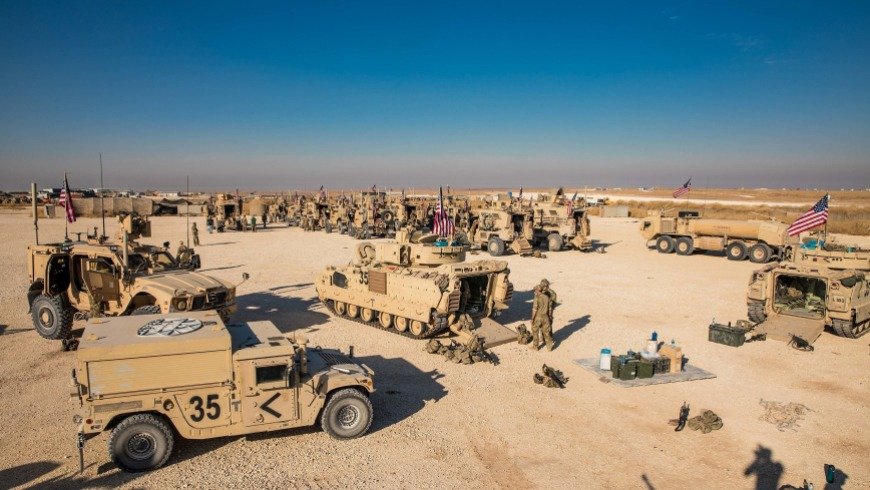
On November 6, 2025, Reuters published an exclusive report stating that the United States is preparing to establish a military presence at an airbase in the Syrian capital, Damascus.
The report relied on information from six informed sources, including two Western officials and a Syrian defense official, indicating that the potential purpose of this presence is to support the implementation of a possible security agreement between Syria and Israel, mediated by the United States.
Base Details and Proposed Use
According to the sources, the airbase is in a strategic location near areas in southern Syria that are expected to be part of a demilitarized zone under the proposed Damascus-Tel Aviv agreement.
The sources noted that the U.S. conducted reconnaissance flights over the base in the past two months, assessing the runway and infrastructure. U.S. C-130 transport planes also landed to test runway readiness.
Syrian media reports, including from Syria TV, indicate that these movements are part of Washington’s broader reassessment of its military strategy in Syria amid regional and strategic changes.
U.S. Central Command (CENTCOM) Commander Admiral Brad Cooper visited Damascus twice, in mid-September and early October—a precedent reflecting unusually high U.S. interest in reshaping influence maps on the ground in Syria, including possible repositioning in southern Syria or near the capital.
Syrian Government Position
In an official response, the Syrian Ministry of Foreign Affairs denied the Reuters report on a U.S. base in Damascus. A ministry spokesperson stated, “There is no truth to what Reuters published regarding U.S. bases in Syria,” adding that the current stage witnesses a shift in the U.S. stance toward direct engagement with the Syrian central government, supporting national unity and rejecting any calls for division.
U.S. Position
The U.S. administration has not issued an official statement confirming or denying the existence of a U.S. military base in Damascus, with spokespeople only noting that the United States continuously evaluates its presence in Syria in support of counter-ISIS efforts and does not comment on specific force locations.
From Counterterrorism to Stability Management
Since 2014, the U.S. military presence in Syria has focused on the security approach of “combating ISIS.” However, the possibility of a U.S. base near Damascus or in southern Syria raises questions about a new U.S. role that may expand the concept of security from counterterrorism to managing stability and building long-term regional balances.
Syrian sources suggest that any potential base would be part of “preventive balancing” to manage regional fluctuations—achieving stability by balancing actors rather than direct confrontation—reflecting a gradual shift from hard-power tools to a networked approach based on partnerships and multi-level coordination.
U.S. Influence Engineering in Syria
Recent U.S. movements and the possibility of a base in southern Syria or near the capital indicate a deeper reassessment of U.S. influence mechanisms in the region, shifting from traditional military deployment to strategic and flexible positioning.
The potential base, even if symbolic, would provide the U.S. with the ability to monitor regional communication lines from Iraq to Lebanon via Jordan, allowing it to manage post-war power balances, a concept referred to as the “regional dynamics arc,” according to Syria TV.
U.S. Military Repositioning
If established, the base’s significance would not only be military but also political and symbolic, reflecting a shift in U.S. presence philosophy from direct operational intervention to symbolic positioning within Syrian sovereignty.
Such a presence is measured not just by its physical size but also by its ability to redefine the U.S. role in post-war Syria—from an external observer to an influential party in shaping the settlement.
Dynamic Stability
Any potential base can be understood within the concept of “dynamic stability,” enabling the U.S. to manage regional changes rapidly and flexibly.
In this context, the U.S. objective is to regulate interactions among key actors in Syria and the region, including Russia, Turkey, and Israel, without direct conflict or full territorial control.
Conclusion
The issue of a potential U.S. military presence in Damascus remains sensitive and complex, intertwining security, strategic, and diplomatic considerations.
Available information relies on media leaks and official sources, indicating U.S. readiness to conduct field assessments of the potential base, while the Syrian government officially denies any U.S. forces on its territory.
This divergence highlights the need to monitor developments to understand future agreements and security management mechanisms in the region, reflecting a potential U.S. shift from counterterrorism toward symbolic and strategic stabilization within Syria and the broader region.
SOURCE: Asian Affairs
About the Author