
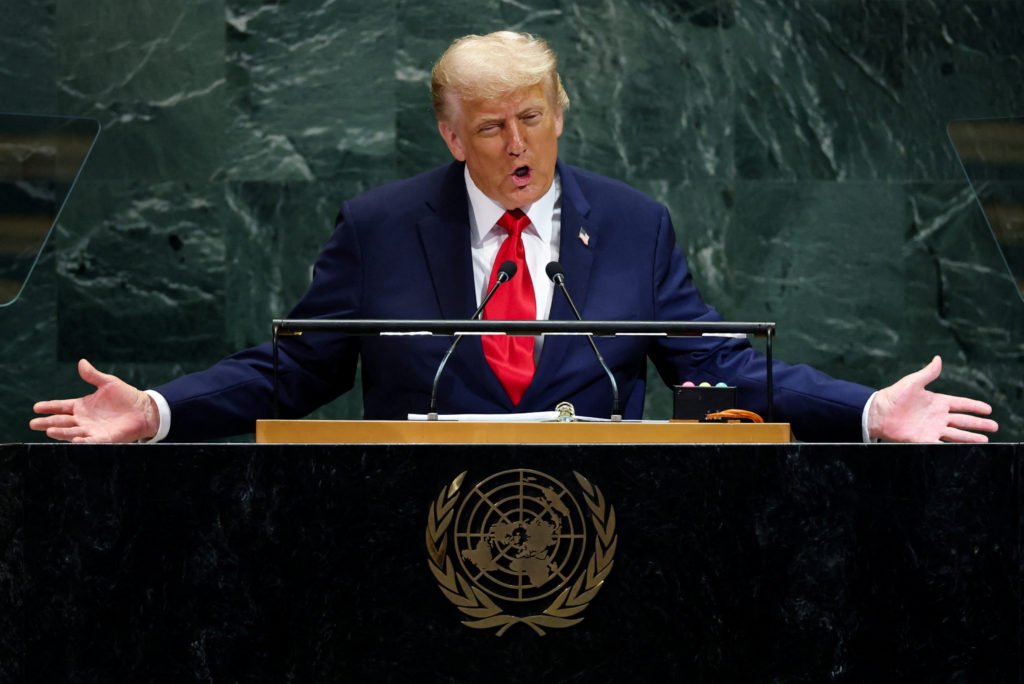
U.S. President Donald Trump addresses the 80th United Nations General Assembly at U.N. headquarters in New York City, U.S., September 23, 2025. REUTERS/MIKE SEGAR
Silk Road – US-Israeli threats against Iran are escalating, three months after the end of the 12-day war in June 2025. Meanwhile, officials in Tel Aviv continue to raise tensions by threatening to bomb Tehran again. Meanwhile, Washington continues to send contradictory signals: sometimes threatening, sometimes demanding a return to negotiations.
US President Donald Trump warned that his country would bomb Iran again if it restarted its nuclear program. “We won’t wait long this time,” he told a gathering of Navy SEALs on Sunday evening, recalling the attacks on Iranian nuclear facilities on June 22.
The escalating Israeli threats recently would not have been possible without an American green light. What’s striking, however, is that the region is witnessing accelerated US military movements that suggest potential preparations for a major military operation, in light of increased air and intelligence activity.
The US military is working to expand the THAAD missile defense base inside Israel, adding five new launchers to the existing six. According to American sources, the base is now capable of accommodating three THAAD batteries at once, equivalent to approximately 38% of Washington’s total THAAD system.
The United States possesses eight operational THAAD batteries, and American media reports indicated that approximately 25% of THAAD interceptor missiles were used to defend Israel against waves of Iranian missiles during the 12-day war.
These figures showed that the THAAD system alone carried out approximately 50% of the US-Israeli interceptions of Iranian MRBMs.
In parallel, four US Air Force tankers departed Al Udeid Air Base in Qatar, coinciding with the departure of two tankers from Souda Bay Air Base, suggesting a repositioning of some fighter jets toward the US mainland.
In the same context, approximately 12 KC-135R/T and KC-46A refueling aircraft were transferred from US bases to Britain before arriving at Al Udeid, in preparation for the transfer of additional fighter jets to the region.
At the same time, the US aircraft carrier USS Gerald R. Ford and its strike group entered the Mediterranean Sea.
In another indication of escalation, a US Navy MQ-4C Triton reconnaissance aircraft was spotted flying over the Gulf near the Strait of Hormuz, departing from Al Dhafra Air Base in the UAE. This aircraft is one of the most prominent aircraft dedicated to intelligence gathering, as it is capable of flying for long hours and capturing accurate images without the need for pilots on board. Although these missions fall within the normal pattern of US surveillance of Iranian movements, the aircraft’s proximity to Iranian airspace carries the risk of escalation.
About the Author