
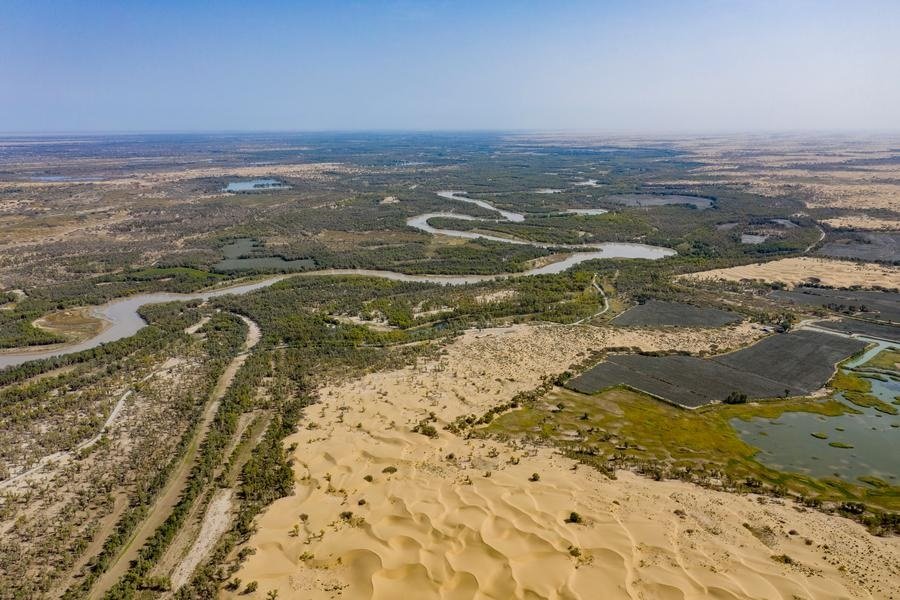
(250930) -- YULI, Sept. 30, 2025 (Xinhua) -- An aerial drone photo taken on Sept. 20, 2025 shows a view of the Tarim River and the vegetation on its banks in Karquga Township of Yuli County, Mongolian Autonomous Prefecture of Bayingolin, northwest China's Xinjiang Uygur Autonomous Region. The Tarim River, which runs along the rim of the barren Tarim Basin, is China's longest inland river, spanning a drainage area of 1.02 million square kilometers. Winding along the northern rim of the Taklimakan Desert, the river nourishes approximately 15 million mu (1 million hectares) of populus euphratica forests flanking its middle and lower reaches, creating a "green corridor" that traverses the desert. In previous decades, factors such as climate change and human activities put excessive pressure on water levels. By the early 1970s, the lower reaches had run dry, and the trees along its banks had all but disappeared. Since 2000, Xinjiang has carried out a series of measures to address these issues. By now, the Tarim River has completed 26 rounds of ecological water diversion, releasing over 10 billion cubic meters of water cumulatively. Data from the project shows that the periodic release of water has alleviated ecological degradation in the target area. The groundwater level has risen, and the number and variety of animals and plants in the area have greatly increased. "The river water has risen back, the populus euphratica trees have sprouted new branches, and the apocynum venetum has also grown up," said Eli Niyaz, a forest ranger in Yuli county. Over the years, local people have been cultivating drought-resistant plants such as populus euphratica, apocynum venetum and oleaster to improve the environment. Monitoring data from the Chinese Academy of Sciences reveal that the vegetation species in the lower reaches of the Tarim River has increased from 17 to 46 types. Wildlife populations along the riverbanks, including Mongolian gazelles, foxes, little egrets, and wild ducks, have rebounded significantly. The ecological restoration of the Tarim River basin is also enabling people who have lived along its banks for generations to benefit from the environmental improvement. (Xinhua/Chen Shuo)
URUMQI-
In late autumn, the Taklimakan Desert, once dubbed “the sea of death,” is witnessing a remarkable transformation.
Along its edges, vibrant green barriers extend into the horizon, where apple trees laden with fruit and flourishing saxaul forests stand resilient against the desert sands, reflecting the growing ecological and economic vitality of southern Xinjiang in far western China.
From saxaul-based medicinal plants to flourishing fruit orchards, these initiatives are not only curbing desertification but also invigorating local industries. The integrated green network, part of the Taklimakan Desert sand-blocking green belt project, has transformed once-barren lands into hubs of sustainable growth.
According to local officials, Xayar County, situated on the northern edge of the desert where sand covers more than 80 percent of the land, stands as a testament to the remarkable resilience of its native species.
“If you ask which plants thrive best in the desert environment of southern Xinjiang, saxaul and tamarisk are undoubtedly the top performers. In particular, saxaul is remarkably suited to saline-alkali soil and groundwater with high alkali levels,” said Wang Kaiyan, deputy director of the poplar forest protection center under the Forestry and Grassland Bureau of Xayar.
He noted that sprawling saxaul forests not only block wind and sand but also support the lucrative cultivation of Cistanche deserticola, a parasitic plant used in traditional medicine.
Xayar has taken full advantage of its natural conditions by encouraging private investment in desert control. According to Wang, the county has cultivated 280,000 mu (about 18,667 hectares) of sand-fixing plants such as saxaul, with 200,000 mu used for Cistanche grafting. This effort now produces more than 10,000 tonnes of fresh Cistanche each year.
Since 2020, the Taklimakan periphery has been designated a national priority for desertification control. In November 2024, a 3,046-kilometer green sand-blocking belt encircling the desert was completed.
In a village in Bachu County, once threatened by encroaching dunes that came within just 30 meters of homes, a blend of biological and engineering measures has reversed the trend. Alongside saxaul and Cistanche, straw checkerboard barriers now cover the towering dunes, interspersed with desert roses and medicinal herbs that anchor the sand and restore vitality to the landscape.
“Since last year, we’ve been experimenting with growing desert-adapted dates, roses and fiber plants on these checkerboards, intercropped with watermelons, and the results are already visible,” said Dai Zhigang, the village’s first secretary, adding that this approach has not only halted sand encroachment but also created new sources of income for the community.
The village now boasts a 65-mu nursery producing over a million saxaul and other seedlings, meeting local needs and supplying neighboring areas.
On the western edge of the Taklimakan in Zepu County, an apple demonstration park stretches across what was once barren desert. Rows of dwarf apple trees, laden with red and yellow fruit, showcase the success of intensive planting techniques.
“This land was once barren, but since 2022, we’ve introduced varieties such as Venus Golden and Qincui using dense dwarfing patterns, achieving a 98 percent survival rate and seeing fruit in just the second year,” said Li Kangkang, head of an agricultural industrial development company.
He projected that the 18,000-mu park would yield over 10,000 tonnes of apples in 2025, with an estimated output value of 1.5 billion yuan (about 211.7 million U.S. dollars).
From Cistanche and nurseries to orchards and herbal bases, these tailored projects demonstrate how desert greening aligns with poverty alleviation. The rise of specialty industries has also sparked a tourism boom, with rural guesthouses and cultural stalls emerging along the desert fringe.
For locals like Bughlich Mahemuti, the changes are tangible. “When I married into this village in 2011, sand piled up inside our house, and I always wanted to move away,” she recalled. Today, with saxaul forests rising 1.5 meters behind her home, sandstorms have receded, and the growth of desert tourism has brought new hope and opportunities.
“Life keeps getting better, and I’m confident about the future,” she said.
source: Xinhua
About the Author