
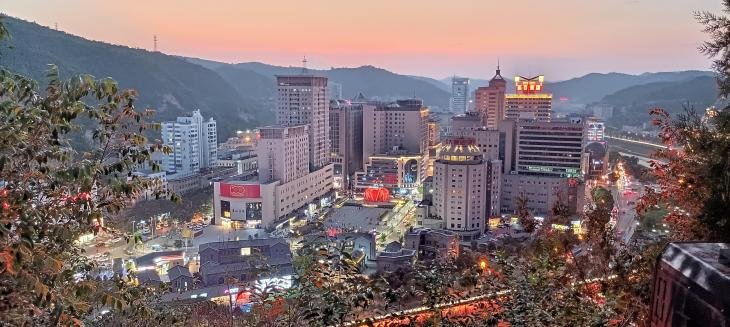
Tourism in China has transformed into a journey through time and mind powered by algorithms, big data, and extended reality. Over the past decade, Beijing has crafted a unique model blending ancient civilization with advanced digital infrastructure, allowing travelers to move between centuries-old murals and AI platforms that anticipate their preferences before they even express them.
This new equation has placed China at the forefront of countries building a tourism industry based on technological innovation rather than traditional sightseeing alone. By the end of 2023, the digital cultural tourism market surpassed one trillion yuan, reflecting the sector’s shift from experimentation to large-scale industry—driven by expansive digital infrastructure, widespread smart payments such as WeChat Pay and Alipay, along with travel apps offering virtual tours, 3D scanning, and interactive digital exhibitions.
A Historical Legacy Revived Digitally
In northern China, within Shanxi Province, an Egyptian student experienced a moment that captured this transformation. As he pointed his flashlight at an ancient mural, the figures seemed to move. This was not an optical illusion, but a hyper-accurate digital replica of a seven-century-old artwork.
The province is known among researchers as an “open-air museum of archaeology,” containing 531 nationally classified heritage sites, including three fully preserved wooden structures from the Tang Dynasty. Since 2015, authorities have launched a comprehensive digital scanning program for immovable cultural relics, using laser technology and close-range imaging to create precise 3D models.
In a digital exhibition in Taiyuan, historic landmarks have been re-presented through light, shadow, and 3D printing, including temples and rock-carved caves. These displays attracted not only historians but also gaming enthusiasts—especially after the global success of Black Myth: Wukong, which recreated real buildings and statues within its virtual world, introducing young audiences to heritage through gameplay before real-world visits.
Digital Archiving: A Civilization’s Memory That Does Not Decay
Digital transformation has evolved from a display tool into a scientific preservation method. Survey teams have collected 3D data from over 350 heritage sites, including about 1,500 buildings, 1,200 statues, and 15,000 square meters of murals—totaling 2.5 petabytes of data, equivalent to millions of high-resolution books.
This archive enables highly accurate restoration, preserving even the smallest cracks and details. Twelve years ago, documenting a temple covering 5,000 square meters took two weeks; today it takes only three days—offering not just speed but unprecedented precision and the possibility of virtual reconstruction in case of damage.
One standout example is the digital model of the Yingxian Wooden Pagoda, the world’s tallest surviving wooden tower at nearly 70 meters. Through scanning, it was recreated as a museum-scale replica identical to the original—an achievement once impossible before advanced 3D measurement technology.
Artificial Intelligence: The New Tour Guide
Paper brochures and traditional guides are no longer the sole sources of information. AI has become a core travel companion, allowing visitors to input budgets and interests to instantly receive tailored itineraries, transportation schedules, dining suggestions, and crowd-avoidance tips.
Major Chinese travel platforms, including subsidiaries of China Travel International and CYTS, have introduced intelligent customer service systems and digital guides that interact via voice and text.
In Xi’an, scanning a QR code reveals a virtual guide modeled as a Tang Dynasty woman who speaks Chinese, English, and Russian, accompanying visitors throughout their tour.
Social media discussions about AI travel planning have drawn hundreds of thousands of posts, showing that modern tourists now seek not just beautiful destinations, but personalized experiences.
Virtual Reality: Traveling Without Leaving Home
At the Mogao Caves, visitors can wear VR headsets to explore Cave 285 in full 360-degree immersion, examining murals from mere centimeters away without touching them—protecting the originals from wear.
5G technology has also enabled live cultural broadcasts from the site to global audiences, with real-time angle selection. These experiences do not replace physical visits but expand accessibility, especially for those unable to travel.
Smart Cities: Destinations in Their Own Right
A new form of travel known as “technology tourism” has emerged, where visitors come not for ancient ruins but to experience innovation itself. Social media has been crucial in spreading this trend; the hashtag #chinatravel alone surpassed 215,000 videos, three-quarters posted within a single year.
Chongqing has become a symbol of this style, often described as a sci-fi city due to metro lines piercing skyscrapers and advanced smart transport systems. Tourism companies such as China Highlights began integrating tech experiences into itineraries as early as 2018, including self-driving cars and drone deliveries.
The result was a surge in foreign tourists following eased entry policies since 2023. In the first half of 2025 alone, visitor numbers exceeded 38 million—up more than 30%. Shanghai and Shenzhen each welcomed millions, highlighting the appeal of tech cities as standalone destinations.
The Digital Economy Driving Tourism Growth
Official figures show that in 2024, the value added by core digital economy sectors reached 14 trillion yuan—10.5% of GDP. Cultural industries totaled 6.2 trillion yuan, while tourism reached 5.86 trillion.
These numbers reflect the fusion between digital and cultural economies, each fueling the other. Every VR experience or smart booking platform generates more data, which leads to more precise services and higher revenues—explaining China’s heavy investment in tourism technology as a strategic economic engine.
Foreign Visitors: Digital Amazement and Cultural Shock
At a culture and tourism expo in Tianjin, international visitors expressed astonishment at the level of technology. One businesswoman used a smart camera that instantly transformed her photo into a traditional Chinese character portrait, while others tested drone deliveries and autonomous vehicles.
A travel blogger from Eastern Europe described the ease of navigation through intelligent systems offering real-time restaurant and attraction tips. Such experiences fueled online sharing, creating a viral effect that attracted even more travelers.
Major tech firms such as Alibaba and Xiaomi have become part of tour programs, while platforms like TikTok have served as powerful media accelerators for this trend.
Smart Payments: A Cashless Economy
One of the most striking features for tourists is the near-total dominance of digital payments, with many shops no longer accepting cash. Visitors often install payment apps before arrival.
Chinese authorities have issued guidelines to enhance digital service accessibility for foreigners, including improving connectivity and enabling foreign e-wallet integration. The 14-measure document includes multilingual services and real-time translation tools—aimed at removing “digital bottlenecks” that hinder non-Chinese speakers.
Drones and Robots: Contactless Services
In some tourist areas, visitors can order food or drinks delivered by drones within minutes. This system operates on over 30 routes in major cities and has completed more than 300,000 orders.
Robots have also entered the sector—from hotel reception to museum information services—reducing operating costs and providing 24/7 assistance. However, this automation has sparked debates about its impact on traditional jobs, even as visitors admire the technological leap.
Video Games: A New Gateway to Heritage
The success of Black Myth: Wukong revealed a new path for tourism promotion. The game digitized real heritage sites into explorable virtual environments, introducing global players to Chinese temples and caves long before encountering them in textbooks.
This model shows how entertainment can become cultural education, turning players into potential tourists and tourists into informal cultural ambassadors.
International Standards and Privacy
Despite progress, challenges remain. Some visitors note language barriers in apps and compatibility issues with foreign systems, while others raise privacy concerns related to data collection.
These issues do not diminish the success of the model but highlight its transitional phase. Authorities have begun addressing these gaps, signaling an official commitment to global usability.
Tourism as Soft Power
Digital transformation has reshaped not only the economy but China’s global image. Travelers who experience high-speed trains, palm-print payments, and virtual museums return home with stories that spread across social media—often surpassing official campaigns in impact.
Digital tourism thus functions as a powerful soft-power tool, showcasing scientific and technological advancement while reinforcing China’s modern identity.
Merging Past and Futur
The essence of China’s experience lies in combining two seemingly opposing elements: the world’s oldest continuous civilization and one of the fastest-growing digital economies. A tourist might stand before a thousand-year-old mural while an AI guide explains it through deep-learning algorithms.
This contrast creates irresistible appeal, turning visits into what many describe as a positive “civilizational shock.”
Toward Predictive Tourism
The next phase points toward predictive tourism, where big data enables platforms to anticipate traveler preferences and suggest personalized routes. Generative AI will shape content creation, trend analysis, and targeted marketing—making travel more individual and less random.
What is unfolding in China is not a minor technological upgrade, but a comprehensive redefinition of tourism—where exploring the world becomes a journey through both place and data.
About the Author