The Chinese Spring Festival, or Lunar New Year, is not merely a passing holiday in the calendar of a major nation. It is a deeply layered civilizational event where myth intersects with history, social ritual with cultural policy, and economics with identity.
It is the most important celebration for the Chinese people for more than four thousand years — a mirror reflecting both ancient and modern China. Each year, between late January and early February, nearly one-fifth of the world’s population enters a shared festive rhythm, in which time is rewritten according to the moon rather than the sun, and a new page of hope, blessings, and good fortune is opened.
In 2025, for example, the festival fell on January 29 and marked the Year of the Snake — a symbol of wisdom, intelligence, and adaptability. In 2026, the official holiday in China extends roughly from mid-February to late February, accompanied by massive waves of travel, shopping, and cultural and commercial activity.
The birth of the Spring Festival
Historically, the first official celebration of the Spring Festival dates back to the Han Dynasty more than two thousand years ago, when the first day of the lunar year was named “New Year’s Day.” Yet its roots are far older, closely tied to agriculture and the seasons of planting and harvest.
Ancient China, essentially a farming civilization, linked spring with the beginning of life’s cycle. Thus spring became a symbol of renewal — even though the festival astronomically falls in the heart of winter. The name “Spring Festival” does not describe the weather, but rather a declaration of intent: we plant today so we may harvest tomorrow.
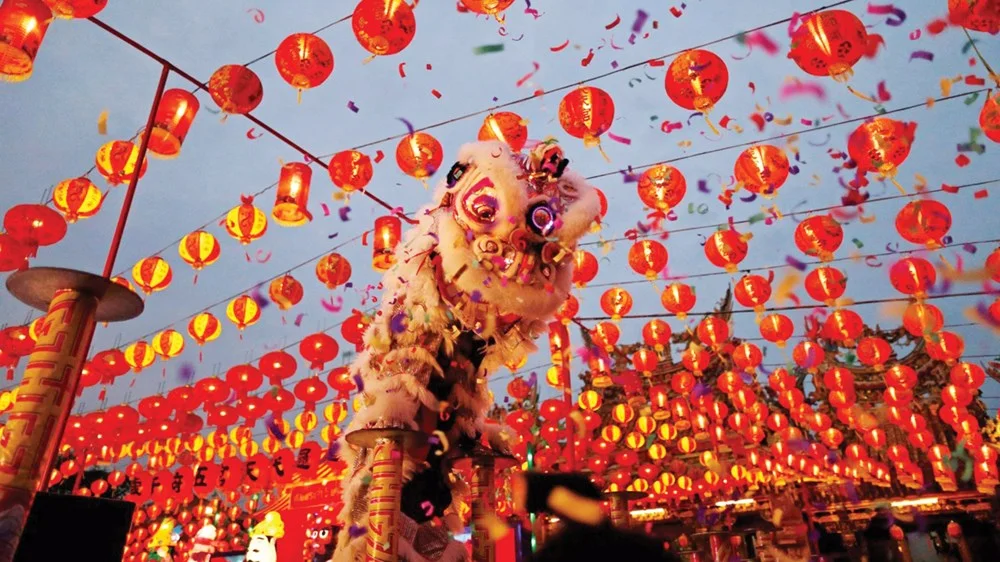
Across successive dynasties — from Sui and Tang to Song and Qing — the rituals evolved from a simple religious observance into a comprehensive popular festival. Dumplings, dragon and lion dances, and in modern times the massive televised New Year’s Gala launched by CCTV in 1983 became central traditions, as important today as the family reunion dinner itself.
The Spring Migration
At the heart of the festival stands the family. Reunion is its core meaning. Millions of workers and students who spend the year in industrial megacities return to their hometowns to sit once again with parents and grandparents around a single table.
This phenomenon is known as Chunyun — the Spring Migration — the largest seasonal human movement on Earth.
In some years, total trips exceed three billion. Tickets sell in thousands per second, and trains, buses, planes, and private cars transform into emotional arteries more than logistical ones.
It is a journey back to one’s roots. The entire country enters a state of transport mobilization. Shops close, supplies are stocked weeks in advance, and in recent years, digital ticket-buying has become an online battlefield no less fierce than the ancient legend that began it all.
Nian and the color red
Legend tells of a monster named Nian that emerged each year to attack villages, driving people to hide in fear — until a brave boy confronted it with fire, loud noise, and fireworks, defeating it forever.
From then on, noise, fire, and the color red became symbolic tools to drive away evil and misfortune.
This is why red dominates everything during the Spring Festival: clothes, lanterns, banners, envelopes, and door decorations. Red became a psychological and cultural shield against chaos.
Fireworks still explode at midnight to mark the death of the old year and the birth of the new. Despite environmental and safety restrictions in major cities, people continue to celebrate in various ways — because ritual often proves stronger than regulation.
A dinner of fortune and blessings
On Lunar New Year’s Eve comes the most important meal of the year: the reunion dinner — a feast whose history stretches back four millennia, with every dish carrying meaning.
Fish is essential, as its pronunciation resembles the word for “surplus,” symbolizing abundance in the coming year.
Dumplings are prepared collectively, especially in northern China. Their shape resembles ancient silver ingots, symbolizing wealth. Some families hide a coin inside one dumpling — whoever finds it is believed to enjoy good luck all year.
While home cooking once dominated, many families now dine out, order through apps, or even hire chefs to cook at home.
Cleaning is forbidden — after the festival begins
Preparations begin days or weeks in advance, with thorough house cleaning — not only for hygiene, but symbolically to remove the bad luck of the old year.
Once the new year starts, however, sweeping is forbidden for the first days, as it might sweep away good fortune.
Other taboos include cutting hair or nails, using knives or scissors, breaking objects, swearing, or uttering negative words such as “death” or “illness.”
Hongbao — the red envelopes
Children reign supreme during the festival. They receive hongbao — red envelopes filled with money, similar to the “Eidiyah” tradition in Arab cultures.
Today these envelopes are increasingly digital, sent through apps like WeChat, with billions of transactions in just days.
New clothes are another essential ritual. Historically, many waited all year for a new garment. The wealthy wore silk, the poor stitched rough fabric — but all shared the desire for a fresh beginning.
Red remains the favored color, and children often wear tiger-patterned hats and shoes believed to ward off evil spirits.
A national ritual
Spending during the Spring Festival accounts for roughly one-third of China’s annual consumer consumption. The economy enters a seasonal frenzy where spiritual ritual merges with mass purchasing.
Technology plays its part: festival-themed games, digital red-envelope competitions, and enormous live broadcasts of the Spring Festival Gala watched by over a billion people.
The CCTV Gala — four and a half hours of music, dance, comedy, opera, and martial arts — has become a modern national ceremony showcasing China’s cultural diversity from countryside to megacity, from ancient heritage to futuristic vision.
In recent years, it has been broadcast in multiple languages, including Arabic and English, turning it into a soft-power instrument connecting China with the world.
The Chinese zodiac
Behind all these rituals lies a larger symbolic system: the Chinese zodiac, with its twelve animals — Rat, Ox, Tiger, Rabbit, Dragon, Snake, Horse, Goat, Monkey, Rooster, Dog, and Pig.
Each year carries an animal’s name and symbolic personality traits. Those born in a given year are believed to inherit its characteristics.
There is also the concept of Ben Ming Nian — the year when one’s zodiac sign returns every twelve years — considered unlucky, prompting people to wear red throughout the year, even in undergarments, for protection.
The festival beyond China
Internationally, the Spring Festival has moved beyond China’s borders. In December 2023, the United Nations General Assembly officially added the Lunar New Year to the UN holiday calendar — a clear recognition of Chinese culture’s global influence.
This decision was not merely cultural, but civilizational and political, reflecting China’s shift from economic power to cultural actor shaping global dialogue.
In this context, President Xi Jinping introduced the “Global Civilization Initiative,” advocating respect for cultural diversity, peaceful coexistence, and dialogue over conflict.
The Spring Festival — with its values of harmony, family unity, and balance between humanity and nature — is presented as a living model of this vision.
A ritual that endures
Ultimately, the Chinese Spring Festival is a vast social laboratory where myth coexists with technology, and tradition survives rapid change.
It shows how a family dinner can resist modern isolation, and how a red decoration on an old wooden door can rival smartphone screens in emotional impact.
About the Author