The 2025 Iraqi parliamentary elections marked a pivotal political event in the trajectory of Iraq’s democratic experience, amid widespread public anticipation and political debate over future alliances and the next government’s direction.
Held on November 11, 2025, the elections saw a higher voter turnout compared to previous cycles, reflecting a shift in public sentiment and a desire to reshape the country’s legislative authority after years of political and economic challenges.
General Context of the Electoral Process
These elections took place amid a complex political landscape characterized by competition between traditional forces and new alliances. More than 7,000 candidates representing various parties and entities competed for 329 parliamentary seats.
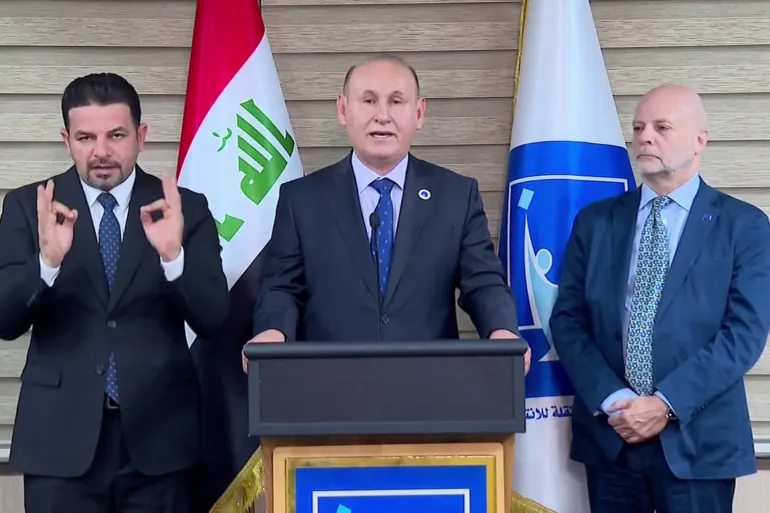
Despite the boycott by some political forces, particularly the Sadrist Movement, the Independent High Electoral Commission (IHEC) confirmed that the process proceeded smoothly, under local and international observation to ensure transparency and integrity.
A special voting day was held earlier for security forces and certain special categories before the general voting day.
Voter Participation and Organizational Measures
The IHEC announced a participation rate of about 56%, the highest since the 2018 elections—interpreted as an indication of the Iraqi people’s desire for change and renewed political engagement.
Voting was conducted using an electronic system, which expedited counting and result transmission from polling stations to central tally centers.
Despite some isolated complaints, oversight bodies confirmed that the elections proceeded peacefully, without major security breaches, thanks to an extensive security plan involving Iraqi forces to secure more than 8,000 polling centers.
Preliminary Results and Power Balances
On November 12, the IHEC announced preliminary results showing the Reconstruction and Development Coalition, led by Prime Minister Mohammed Shia’ Al-Sudani, in the lead across most Shia provinces and Baghdad.
It was followed by the Taqaddum (Progress) Alliance led by Mohammed Al-Halbousi, and then the State of Law Coalition under Nouri Al-Maliki, while the Kurdistan Democratic Party (KDP) achieved a notable advance within the Kurdistan Region.
Observers believe this outcome strengthens Al-Sudani’s position in forming the next government but also presents challenges in achieving broad parliamentary consensus.
Role of Domestic and International Monitoring
The international community and local organizations devoted significant attention to observing the 2025 Iraqi elections as a gauge of Iraq’s democratic stability.
UN and EU missions, along with several Iraqi civil society groups, monitored the process. Most reports praised the smooth technical and organizational conduct of the elections.
The UN Assistance Mission for Iraq (UNAMI) stated that measures taken by the IHEC effectively reduced opportunities for fraud and manipulation, though some observations noted delays in final result announcements and variations in observer performance across provinces.
A notable development was the increased participation of young local volunteers as observers, which enhanced transparency and fostered voter confidence. This broad monitoring engagement represents a key step toward entrenching free and fair electoral standards and strengthening citizens’ belief in the power of their vote to influence national policymaking.
Challenges and Future Prospects
Despite the technical success of the elections, the incoming government faces significant challenges, including:
Rebuilding public trust in political institutions after years of corruption and division.
Improving basic services in electricity, water, education, and health.
Managing regional and international balances while maintaining Iraq’s sovereign decision-making.
Empowering youth and women in the emerging political scene.
The relatively high voter turnout underscores that Iraqis remain committed to change through the ballot box, despite past frustrations—placing great responsibility on the political class to translate this will into tangible reform.
Conclusion
The 2025 Iraqi elections were more than a routine political exercise; they represented a renewal of legitimacy and the beginning of a new phase of political recalibration.
The victory of the Reconstruction and Development Coalition signals a measure of public confidence in continuity and state stability. However, it also presents a crucial test in forming a strong, reform-oriented government capable of meeting citizens’ expectations.
The coming days will be decisive in shaping the alliances that define Iraq’s political landscape for the years ahead, as Iraqis look toward a future of security, justice, and development.
source: Asian Affairs – Dima Daaboul
About the Author