Xiong’an New Area advances high-quality development alongside effective governance
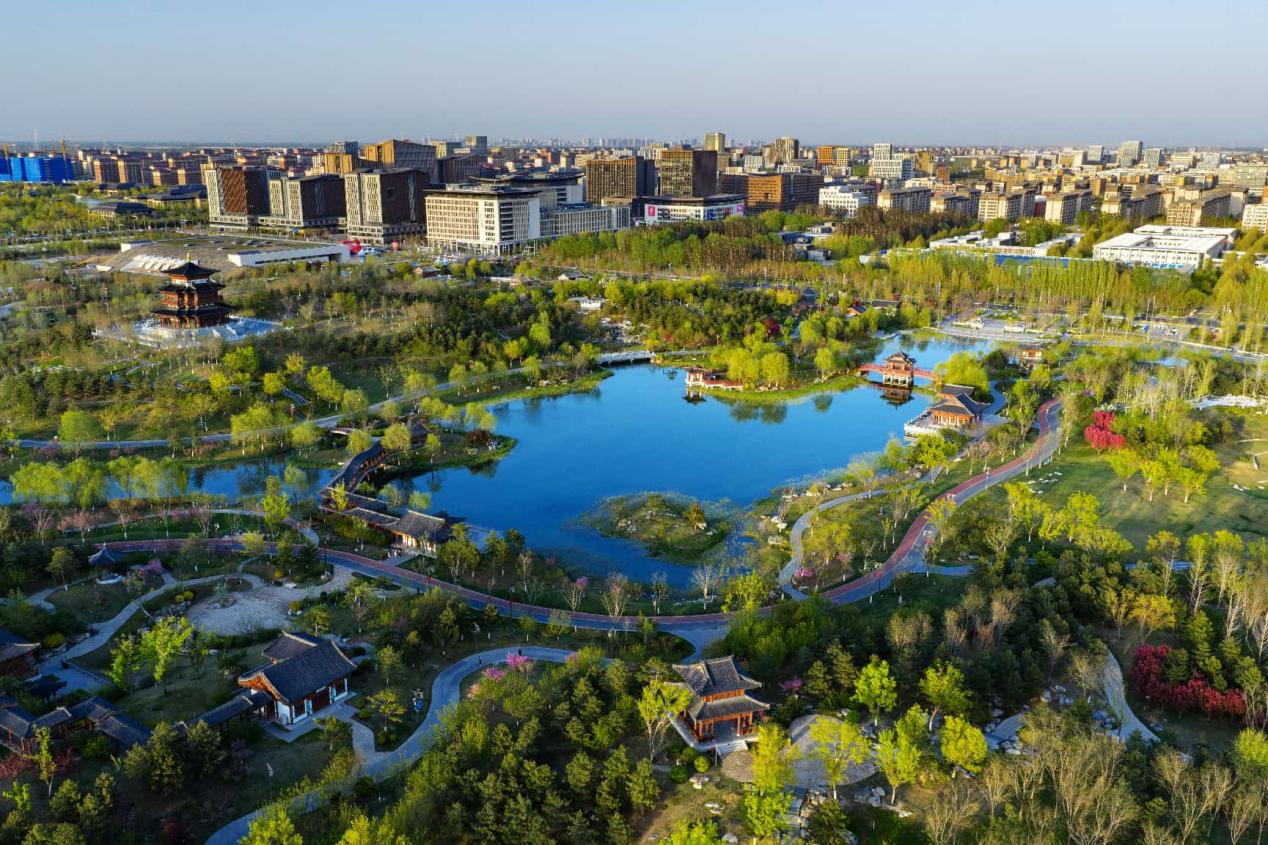
Photo shows Yuerong Park in Xiong’an New Area, north China’s Hebei province. (Photo/Yang Yawen)
Above ground, expansive green spaces blend seamlessly with modern architecture. Beneath the surface, a network spanning more than 100 kilometers links underground utility corridors that deliver water, electricity, gas, heating, and communications.
In the cloud, a digital city is taking shape alongside the physical one, while the Xiong’an Urban Computing Center keeps watch over the entire city. A “city of the future” is steadily taking shape in the Xiong’an New Area, north China’s Hebei province.
Rejecting sprawling, haphazard urban expansion, Xiong’an has adopted a different approach, with planning preceding construction, underground infrastructure built before above-ground development, and trees planted before the city takes shape. Modern governance has been integrated into every stage of urban development.
In the Rongdong area, the first developed urban area in Xiong’an, trees flourish and buildings stand in neat rows. There are no tangled overhead power lines, and the roads show no signs of repeated digging and patching.
The underground parking facilities beneath 95 residential complexes are interconnected. Underground utility corridors accommodate municipal pipelines for water, electricity, gas, heating and communications, while smart sensors monitor conditions throughout the corridors. The “BeiDou + 5G indoor distribution system” brings BeiDou signals underground. Smart sensors distributed throughout the tunnels monitor environmental conditions in real time, enabling proactive maintenance. “Traffic flows smoothly both above and below ground. Living here feels safe and convenient,” said Zhou Qiang, a local resident.

Residents seek assistance at a public service center in Yi’an Community, Xiong’an New Area, north China’s Hebei province. (Photo/Yang Yawen)
By prioritizing subsurface infrastructure, Xiong’an has built resilience into its foundation while deploying digital twin technology to create a synchronized virtual environment. Ma Yongjun, head of operations of the infrastructure construction company of China Xiong’an Group, starts each workday by logging into the digital twin system. The system provides a detailed view of the utility tunnels, with real-time updates on temperature, humidity, water pressure, and gas concentrations.
“When a problem arises, the system automatically issues an alert. It can be detected in the cloud and addressed directly inside the utility tunnel,” Ma said.
Under clear autumn skies, birds flock to the Yannan dike of Baiyangdian Lake, while the Nanhe water conservancy hub is reflected in the water. The hub links the vast wetlands of Baiyangdian on one side with Xiong’an’s modern buildings on the other.
Before the Xiong’an New Area was established, water quality across Baiyangdian was generally classified as worse than Grade V under Chia’s water quality standards. Water flows had declined, and the waterways had become severely fragmented. At the Fuhe River estuary wetland, the gateway to Baiyangdian, polluted upstream water once flowed directly into the lake.
Zhu Baofeng, head of the water conservancy and water environment construction and operations division at China Xiong’an Group Ecological Construction Investment Co., Ltd., led his team in restoring the wetland through nature-based purification techniques, breathing new life into the wetland.
In recent years, Xiong’an has taken an integrated approach to replenishing water supplies, tackling pollution and preventing floods. It has advanced five major initiatives in parallel, including dredging waterways, linking lakes and ponds, restoring wetlands, replenishing water supplies in a science-based manner, and strengthening flood control.
“Baiyangdian has returned to its former vitality!” said Zhang Xuenong, chairman of the Baiyangdian Photographers Association in Anxin county, who has documented the lake’s transformation in more than 100,000 photos. In recent years, rare birds such as the Baer’s Pochard have frequently appeared in his photographs.

Photo taken on April 10, 2026 shows the start-up zone of Xiong’an New Area, north China’s Hebei province. (Photo/Yang Yawen)
“The city and the lake now complement each other, and every shot captures a beautiful scene,” Zhang said.
Water quality in Baiyangdian has remained stable at Grade III for five consecutive years. As of 2026, the number of wild bird species recorded there has risen to 296, up 90 from before the Xiong’an New Area was established. The number of fish species has recovered to 50.
“It feels like living in a garden,” said Yuan Yuxin, a resettled resident who moved with his family into Lixian Garden residential community in Rongdong area in 2023.
“There’s a supermarket just a few minutes’ walk away, and my grandchildren live close to their schools. I play ball at the community senior care center every day. Life is fulfilling and comfortable,” Yuan said.
In Nanwenying Community, where Yuan lives, household files document residents’ needs and everyday concerns.
“We maintain individual files for each of our more than 3,700 households, covering matters such as health care and elderly care. We update them every two months,” said Wang Weixiao, head of the Nanwenying Community.
The records have been organized into more than 80,000 entries and distilled into three lists covering available resources, residents’ needs and concerns, and responsibilities. This helps streamline the many tasks involved in community governance, said Wang.
A stable home is the foundation for a fulfilling life and career. With equitable, high-quality public services, meticulous community-level governance and a thriving industrial base, Xiong’an is helping residents build settled homes and fulfilling lives.
“Governance is not something to be addressed after construction is complete. Xiong’an has integrated planning, construction and governance from the outset, ensuring that urban management is guided by clear rules from the very beginning,” said Liu Zhenming, deputy director of the Natural Resources and Planning Bureau of the Xiong’an New Area.
المصدر: en.people.cn
About the Author